Current issue
Accepted manuscript
About the Journal
Scientific Council
Editorial Board
Regulatory and archival policy
Code of publishing ethics
Publisher
Information about the processing of personal data in relation to cookies and newsletter subscription
Archive
For Authors
For Reviewers
Contact
Reviewers
Annals reviewers in 2025
Annals reviewers in 2024
Annals reviewers in 2023
Annals reviewers in 2022
Annals reviewers in 2021
Annals reviewers in 2020
Annals reviewers in 2019
Annals reviewers in 2018
Annals reviewers in 2017
Annals reviewers in 2016
Annals reviewers in 2015
Annals reviewers in 2014
Annals reviewers in 2013
Annals reviewers in 2012
Links
Sklep Wydawnictwa SUM
Biblioteka Główna SUM
Śląski Uniwersytet Medyczny w Katowicach
Privacy policy
Accessibility statement
Reviewers
Annals reviewers in 2025
Annals reviewers in 2024
Annals reviewers in 2023
Annals reviewers in 2022
Annals reviewers in 2021
Annals reviewers in 2020
Annals reviewers in 2019
Annals reviewers in 2018
Annals reviewers in 2017
Annals reviewers in 2016
Annals reviewers in 2015
Annals reviewers in 2014
Annals reviewers in 2013
Annals reviewers in 2012

HCM Risk-SCD score and its relation with functional status and comorbidities in HCM patients
1
Students’ Scientific Club, Department of Cardiology, Faculty of Medical Sciences in Katowice, Medical University of Silesia, Katowice, Poland
2
1st Department of Cardiology, Leszek Giec Upper-Silesian Medical Centre of the Medical University of Silesia, Katowice, Poland; European Reference Network for Rare and Low Prevalence Complex Diseases of the Heart (ERN GUARD-Heart)
Corresponding author
Barbara Krywult
Studenckie Koło Naukowe, Klinika Kardiologii I Katedry Kardiologii, Wydział Nauk Medycznych w Katowicach ŚUM, ul. Ziołowa 47, 40-635 Katowice, tel. +48 32 359 88 90, e-mail: 1klinkard@sum.edu.pl
Studenckie Koło Naukowe, Klinika Kardiologii I Katedry Kardiologii, Wydział Nauk Medycznych w Katowicach ŚUM, ul. Ziołowa 47, 40-635 Katowice, tel. +48 32 359 88 90, e-mail: 1klinkard@sum.edu.pl

KEYWORDS
TOPICS
ABSTRACT
Introduction:
Hypertrophic cardiomyopathy (HCM) is a genetic cardiac disorder associated with heart failure, arrhythmias, and an increased risk of sudden cardiac death (SCD). Functional status and the HCM Risk-SCD score are key parameters guiding management. This study assessed the relationship between functional status, comorbidity burden, and the HCM Risk-SCD score in patients with HCM.
Material and methods:
This retrospective single-cohort study included 56 patients with HCM. The HCM Risk-SCD score was calculated according to the 2023 ESC guidelines. Patients were stratified by heart failure symptoms into asymptomatic (NYHA I) and symptomatic (NYHA II–III) groups, and by comorbidity burden into low (0–1) and high (≥2) groups. Assessed comorbidities included systemic hypertension, hyperlipidemia, coronary artery disease, chronic kidney disease, COPD, and type 2 diabetes.
Results:
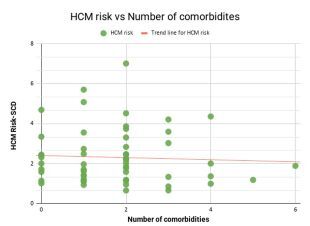
The median HCM Risk-SCD score was higher in asymptomatic than symptomatic patients (3.46% [IQR 2.38-4.44] vs. 2.07% [IQR 1.17-2.23]; p=0.005). No significant difference was observed between patients with low and high comorbidity burden (1.95% vs. 2.01%; p=0.765), and no correlation was found between the HCM Risk-SCD score and the number of comorbidities (rho=-0.07, p=0.607).
Conclusions:
Asymptomatic patients with HCM had a higher estimated risk of SCD than symptomatic patients. The HCM Risk-SCD score appeared to be independent of comorbidity burden. This shows that HCM individuals with better clinical and functional status may be at higher risk of SCD.
FUNDING
This research received no external funding.
CONFLICT OF INTEREST
The authors declare no conflict of interest.
INFORMED CONSENT
Informed consent was not required due to the retrospective, anonymous design.
AUTHORS' CONTRIBUTIONS
Study design – K. Mizia-Stec, M. Podolski; Data collection – K. Nogala, J. Nowak, lek. M. Podolski, J. Kromołowski, B. Krywult, M. Kaspera, Z. Niedoba; Data interpretation – Z. Niedoba, M. Kaspera, B. Krywult, J. Kromołowski, J. Nowak, K. Nogala; Statistical analysis – J. Kromołowski; Manuscript preparation – B. Krywult; Literature research – Z. Niedoba, B. Krywult, M. Kaspera; Final approval of the version to be published – K. Mizia-Stec, M. Podolski, B. Krywult, J. Kromołowski, M. Kaspera, Z. Niedoba, K. Nogala, J. Nowak
PEER REVIEW INFORMATION
Article has been screened for originality
REFERENCES (21)
1.
Liew AC, Vassiliou VS, Cooper R, Raphael CE. Hypertrophic Cardiomyopathy–Past, Present and Future. J Clin Med. 2017;6(12):118. doi: 10.3390/jcm6120118.
2.
Arbelo E, Protonotarios A, Gimeno JR, Arbustini E, Barriales-Villa R, Basso C, et al. 2023 ESC Guidelines for the management of cardiomyopathies: Developed by the task force on the management of cardiomyopathies of the European Society of Cardiology (ESC). Eur Heart J. 2023;44(37):3503–3626. doi: 10.1093/eurheartj/ehad194.
3.
Marian AJ, Braunwald E. Hypertrophic Cardiomyopathy: Genetics, Pathogenesis, Clinical Manifestations, Diagnosis, and Therapy. Circ Res. 2017;121(7):749–770. doi: 10.1161/CIRCRESAHA.117.311059.
4.
Schlittler M, Pramstaller PP, Rossini A, De Bortoli M. Myocardial Fibrosis in Hypertrophic Cardiomyopathy: A Perspective from Fibroblasts. Int J Mol Sci. 2023;24(19):14845. doi: 10.3390/ijms241914845.
5.
Aguiar Rosa S, Thomas B, Fiarresga A, Papoila AL, Alves M, Pereira R, et al. The Impact of Ischemia Assessed by Magnetic Resonance on Functional, Arrhythmic, and Imaging Features of Hypertrophic Cardiomyopathy. Front Cardiovasc Med. 2021;8:761860. doi: 10.3389/fcvm.2021.761860.
6.
Cheng Z, Fang T, Huang J, Guo Y, Alam M, Qian H. Hypertrophic Cardiomyopathy: From Phenotype and Pathogenesis to Treatment. Front Cardiovasc Med. 2021;8:722340. doi: 10.3389/fcvm.2021.722340.
7.
Sanchez DJ, Lozano IF. Implantable cardioverter-defibrillator in hypertrophic cardiomyopathy. Glob Cardiol Sci Pract. 2018;2018(3):31. doi: 10.21542/gcsp.2018.31.
8.
Maron BJ, Shen WK, Link MS, Epstein AE, Almquist AK, Daubert JP, et al. Efficacy of implantable cardioverter-defibrillators for the prevention of sudden death in patients with hypertrophic cardiomyopathy. N Engl J Med. 2000;342(6):365–373. doi: 10.1056/NEJM200002103420601.
9.
Maron BJ, Estes NAM, Rowin EJ, Maron MS, Reynolds MR. Development of the Implantable Cardioverter-Defibrillator: JACC Historical Breakthroughs in Perspective. J Am Coll Cardiol. 2023;82(4):353–373. doi: 10.1016/j.jacc.2023.04.056.
10.
Wang N, Xie A, Tjahjono R, Tian DH, Phan S, Yan TD, et al. Implantable cardioverter defibrillator therapy in hypertrophic cardiomyopathy: an updated systematic review and meta-analysis of outcomes and complications. Ann Cardiothorac Surg. 2017;6(4):298–306. doi: 10.21037/acs.2017.07.05.
11.
Pay L, Çetin T, Dereli Ş, Kadı H, Yumurtaş AÇ, Çınar T, et al. Validation of the HCM Risk-SCD model in patients with hypertrophic cardiomyopathy and future perspectives. Pacing Clin Electrophysiol. 2023;46(12):1519–1525. doi: 10.1111/pace.14876.
12.
Norrish G, Niemiec M, Kaski JP, Mizia-Stec K. How to assess sudden cardiac death risk in hypertrophic cardiomyopathy? Current challenges and future directions. Kardiol Pol. 2025;83(1):8–17. doi: 10.33963/v.phj.104052.
13.
García-Giustiniani D, Arad M, Ortíz-Genga M, Barriales-Villa R, Fernández X, Rodríguez-García I, et al. Phenotype and prognostic correlations of the converter region mutations affecting the β myosin heavy chain. Heart 2015;101(13):1047–1053. doi: 10.1136/heartjnl-2014-307205.
14.
Liu J, Wang D, Ruan J, Wu G, Xu L, Jiang W, et al. Identification of heart failure with preserved ejection fraction helps risk stratification for hypertrophic cardiomyopathy. BMC Med. 2022;20(1):21. doi: 10.1186/s12916-021-02219-7.
15.
Maron MS, Olivotto I, Betocchi S, Casey SA, Lesser JR, Losi MA, et al. Effect of left ventricular outflow tract obstruction on clinical outcome in hypertrophic cardiomyopathy. N Engl J Med. 2003;348(4):295–303. doi: 10.1056/NEJMoa021332.
16.
Maron BJ, Olivotto I, Maron MS. The dilemma of left ventricular outflow tract obstruction and sudden death in hypertrophic cardiomyopathy: do patients with gradients really deserve prophylactic defibrillators? Eur Heart J. 2006;27(16):1895–1897. doi: 10.1093/eurheartj/ehl130.
17.
Pozios I, Corona-Villalobos C, Sorensen LL, Bravo PE, Canepa M, Pisanello C, et al. Comparison of Outcomes in Patients With Nonobstructive, Labile-Obstructive, and Chronically Obstructive Hypertrophic Cardiomyopathy. Am J Cardiol. 2015;116(6):938–944. doi: 10.1016/j.amjcard.2015.06.018.
18.
Kingma J, Simard C, Drolet B. Overview of Cardiac Arrhythmias and Treatment Strategies. Pharmaceuticals (Basel). 2023;16(6):844. doi: 10.3390/ph16060844.
19.
Varnava AM, Elliott PM, Mahon N, Davies MJ, McKenna WJ. Relation between myocyte disarray and outcome in hypertrophic cardiomyopathy. Am J Cardiol. 2001;88(3):275–279. doi: 10.1016/s0002-9149(01)01640-x.
20.
Sridharan A, Maron MS, Carrick RT, Madias CA, Huang D, Cooper C, et al. Impact of comorbidities on atrial fibrillation and sudden cardiac death in hypertrophic cardiomyopathy. J Cardiovasc Electrophysiol. 2022;33(1):20–29. doi: 10.1111/jce.15304.
21.
Thakkar K, Karajgi AR, Kallamvalappil AM, Avanthika C, Jhaveri S, Shandilya A, et al. Sudden cardiac death in childhood hypertrophic cardiomyopathy. Dis Mon. 2023;69(4):101548. doi: 10.1016/j.disamonth.2023.101548.
| eISSN: | 1734-025X |


The Medical University of Silesia in Katowice, as the Operator of the annales.sum.edu.pl website, processes personal data collected when visiting the website. The function of obtaining information about Users and their behavior is carried out by voluntarily entered information in forms, saving cookies in end devices, as well as by collecting web server logs, which are in the possession of the website Operator. Data, including cookies, are used to provide services in accordance with the Privacy policy.
You can consent to the processing of data for these purposes, refuse consent or access more detailed information.
You can consent to the processing of data for these purposes, refuse consent or access more detailed information.