Current issue
Accepted manuscript
About the Journal
Scientific Council
Editorial Board
Regulatory and archival policy
Code of publishing ethics
Publisher
Information about the processing of personal data in relation to cookies and newsletter subscription
Archive
For Authors
For Reviewers
Contact
Reviewers
Annals reviewers in 2025
Annals reviewers in 2024
Annals reviewers in 2023
Annals reviewers in 2022
Annals reviewers in 2021
Annals reviewers in 2020
Annals reviewers in 2019
Annals reviewers in 2018
Annals reviewers in 2017
Annals reviewers in 2016
Annals reviewers in 2015
Annals reviewers in 2014
Annals reviewers in 2013
Annals reviewers in 2012
Links
Sklep Wydawnictwa SUM
Biblioteka Główna SUM
Śląski Uniwersytet Medyczny w Katowicach
Privacy policy
Accessibility statement
Reviewers
Annals reviewers in 2025
Annals reviewers in 2024
Annals reviewers in 2023
Annals reviewers in 2022
Annals reviewers in 2021
Annals reviewers in 2020
Annals reviewers in 2019
Annals reviewers in 2018
Annals reviewers in 2017
Annals reviewers in 2016
Annals reviewers in 2015
Annals reviewers in 2014
Annals reviewers in 2013
Annals reviewers in 2012

Hyperopia in children – from emmetropisation to spectacle correction: A narrative review
1
Oddział Okulistyki Dziecięcej, Zespół Szpitali Miejskich w Chorzowie / Department of Paediatrics Ophthalmology, ZSM Hospital, Chorzów, Poland
2
Department of Ophthalmology, Faculty of Medical Sciences in Zabrze, Medical University of Silesia, Katowice, Poland
3
Scientific Research Facility, Branch in Bielsko-Biała, Medical University of Silesia, Katowice, Poland
Corresponding author
Emilia Wnękowicz-Augustyn
Oddział Okulistyki Dziecięcej, Zespół Szpitali Miejskich w Chorzowie, ul. Truchana 7, 41-500 Chorzów, tel. +48 32 349 00 33
Oddział Okulistyki Dziecięcej, Zespół Szpitali Miejskich w Chorzowie, ul. Truchana 7, 41-500 Chorzów, tel. +48 32 349 00 33

KEYWORDS
TOPICS
ABSTRACT
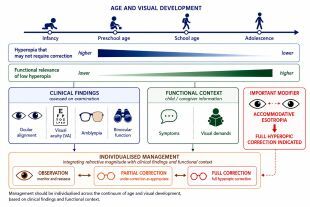
Hyperopia is a common refractive state in childhood and may represent a physiological, age-dependent stage of refractive development. However, refractive magnitude alone does not determine its clinical significance, which also depends on the child's age, associated ocular findings and functional context. This narrative review provides an overview of emmetropisation in childhood, with particular emphasis on the relationship between hyperopia, refractive development and spectacle correction. Longitudinal studies demonstrate substantial age-related changes in ocular biometry and refractive error, while baseline hyperopia may influence the subsequent refractive trajectory. Whether spectacle correction modifies emmetropisation remains uncertain. Available clinical studies differ considerably in age at treatment initiation, baseline refractive error, degree of correction and clinical phenotype, limiting direct comparisons between studies. Studies comparing spectacle correction with observation do not demonstrate a simple, universal effect of correction on emmetropisation. Current clinical guidelines also differ in their numerical thresholds for prescribing correction but consistently emphasise the importance of visual function and ocular alignment. Across the available recommendations, younger age, higher hyperopia, amblyopia risk, reduced visual acuity, anisometropia and manifest strabismus are important factors in determining whether spectacle correction is indicated. Clinical management should therefore be individualised rather than based on refractive magnitude alone. Accommodative esotropia represents an important clinical modifier requiring full hyperopic correction, whereas observation with periodic reassessment may be appropriate in selected children without significant visual dysfunction. Overall, management should balance the potential for refractive development against the risks of amblyopia, strabismus and impaired visual function.
FUNDING
None
CONFLICT OF INTEREST
The authors declare no conflict of interest.
AUTHORS' CONTRIBUTIONS
Study design – E. Wnękowicz-Augustyn, S. Teper; Data collection – E. Wnękowicz-Augustyn; Manuscript preparation – E. Wnękowicz-Augustyn; Literature research – E. Wnękowicz-Augustyn; Final approval of the version to be published – E. Wnękowicz-Augustyn, S. Teper
PEER REVIEW INFORMATION
Article has been screened for originality
REFERENCES (25)
1.
Mutti DO, Hayes JR, Mitchell GL, Jones LA, Moeschberger ML, Cotter SA, et al. Refractive error, axial length, and relative peripheral refractive error before and after the onset of myopia. Invest Ophthalmol Vis Sci. 2007;48(6):2510–2519. doi: 10.1167/iovs.06-0562.
2.
Mutti DO, Mitchell GL, Jones LA, Friedman NE, Frane SL, Lin WK, et al. Axial growth and changes in lenticular and corneal power during emmetropization in infants. Invest Ophthalmol Vis Sci. 2005;46(9):3074–3080. doi: 10.1167/iovs.04-1040.
3.
Ciner EB, Kulp MT, Maguire MG, Pistilli M, Candy TR, Moore B, et al. Visual Function of Moderately Hyperopic 4- and 5-Year-Old Children in the Vision in Preschoolers – Hyperopia in Preschoolers Study. Am J Ophthalmol. 2016;170:143–152. doi: 10.1016/j.ajo.2016.07.017.
4.
Kulp MT, Ying GS, Huang J, Maguire M, Quinn G, Ciner EB, et al. Associations between hyperopia and other vision and refractive error characteristics. Optom Vis Sci. 2014;91(4):383–389. doi: 10.1097/OPX.0000000000000223.
5.
Wilson LB, Melia M, Kraker RT, VanderVeen DK, Hutchinson AK, Pineles SL, et al. Accuracy of Autorefraction in Children: A Report by the American Academy of Ophthalmology. Ophthalmology. 2020;127(9):1259–1267. doi: 10.1016/j.ophtha.2020.03.004.
6.
Jones-Jordan L, Wang X, Scherer RW, Mutti DO. Spectacle correction versus no spectacles for prevention of strabismus in hyperopic children. Cochrane Database Syst Rev. 2020;4(4):CD007738. doi: 10.1002/14651858.CD007738.pub3.
7.
Atkinson J, Anker S, Bobier W, Braddick O, Durden K, Nardini M, et al. Normal emmetropization in infants with spectacle correction for hyperopia. Invest Ophthalmol Vis Sci. 2000;41(12):3726–3731.
8.
Hopkisson B, Arnold P, Billingham B, McGarrigle M, Shribman S. Can retinoscopy be used to screen infants for amblyopia? A longitudinal study of refraction in the first year of life. Eye (Lond). 1992;6(Pt 6):607–609. doi: 10.1038/eye.1992.131.
9.
Mutti DO, Sinnott LT, Lynn Mitchell G, Jordan LA, Friedman NE, Frane SL, et al. Ocular Component Development during Infancy and Early Childhood. Optom Vis Sci. 2018;95(11):976–985. doi: 10.1097/OPX.0000000000001296.
10.
Flitcroft DI. Emmetropisation and the aetiology of refractive errors. Eye (Lond). 2014;28(2):169–179. doi: 10.1038/eye.2013.276.
11.
Rozema JJ. Refractive development I: Biometric changes during emmetropisation. Ophthalmic Physiol Opt. 2023;43(3):347–367. doi: 10.1111/opo.13094.
12.
Schein Y, Yu Y, Ying GS, Binenbaum G. Emmetropization during Early Childhood. Ophthalmology. 2022;129(4):461–463. doi: 10.1016/j.ophtha.2021.11.021.
13.
Troilo D, Smith EL 3rd, Nickla DL, Ashby R, Tkatchenko AV, Ostrin LA, et al. IMI - Report on Experimental Models of Emmetropization and Myopia. Invest Ophthalmol Vis Sci. 2019;60(3):M31–M88. doi: 10.1167/iovs.18-25967.
14.
Mutti DO. To emmetropize or not to emmetropize? The question for hyperopic development. Optom Vis Sci. 2007;84(2):97–102. doi: 10.1097/OPX.0b013e318031b079.
15.
Ingram RM, Arnold PE, Dally S, Lucas J. Results of a randomised trial of treating abnormal hypermetropia from the age of 6 months. Br J Ophthalmol. 1990;74(3):158–159. doi: 10.1136/bjo.74.3.158.
16.
Morrison AM, Robich ML, Jordan LA, Sinnott LT, Mutti DO. Emmetropization in highly hyperopic infants: A randomized clinical trial of partial refractive correction. Optom Vis Sci. 2025;102(5):310–319. doi: 10.1097/OPX.0000000000002254.
17.
Pediatric Eye Disease Investigator Group; Kulp MT, Holmes JM, Dean TW, Suh DW, Kraker RT, Wallace DK, et al. A Randomized Clinical Trial of Immediate versus Delayed Glasses for Moderate Hyperopia in 1- and 2-Year-Olds. Ophthalmology. 2019;126(6):876–887. doi: 10.1016/j.ophtha.2018.12.049.
18.
Holmes JM, Kulp MT, Dean TW, Suh DW, Kraker RT, Wallace DK, et al. A Randomized Clinical Trial of Immediate Versus Delayed Glasses for Moderate Hyperopia in Children 3 to 5 Years of Age. Am J Ophthalmol. 2019;208:145–159. doi: 10.1016/j.ajo.2019.06.021.
19.
Demirkilinç Biler E, Uretmen O, Köse S. The effect of optical correction on refractive development in children with accommodative esotropia. J AAPOS. 2010;14(4):305–310. doi: 10.1016/j.jaapos.2010.01.017.
20.
Bullimore MA, Saunders KJ, Baraas RC, Berntsen DA, Chen Z, Chia AWL, et al. IMI—Interventions for Controlling Myopia Onset and Progression 2025. Invest Ophthalmol Vis Sci. 2025;66(12):39. doi: 10.1167/iovs.66.12.39.
21.
Polskie Towarzystwo Okulistyczne / Sekcja Okulistyki Dziecięcej i Leczenia Zeza. Wytyczne dotyczące postępowania w przypadku zeza u dzieci [pdf]. Polskie Towarzystwo Okulistyczne, 2021 [online] https://pto.com.pl/wytyczne-pt... [accessed on 15 August 2026].
22.
Polskie Towarzystwo Okulistyczne / Sekcja Okulistyki Dziecięcej i Leczenia Zeza. Wytyczne dotyczące postępowania w przypadku niedowidzenia u dzieci [pdf]. Polskie Towarzystwo Okulistyczne, 2021 [online] https://pto.com.pl/wytyczne-pt... [accessed on 15 August 2026].
23.
Hutchinson AK, Morse CL, Hercinovic A, Cruz OA, Sprunger DT, Repka MX, et al. Pediatric Eye Evaluations Preferred Practice Pattern. Ophthalmology. 2023;130(3):P222–P270. doi: 10.1016/j.ophtha.2022.10.030.
24.
Royal College of Ophthalmologists. Guidelines for the Management of Strabismus in Childhood [pdf]. Royal College of Ophthalmologists. London 2012; https://curriculum.rcophth.ac.... [accessed on 15 August 2026].
25.
Mayer DL, Hansen RM, Moore BD, Kim S, Fulton AB. Cycloplegic refractions in healthy children aged 1 through 48 months. Arch Ophthalmol. 2001;119(11):1625–1628. doi: 10.1001/archopht.119.11.1625.
| eISSN: | 1734-025X |


The Medical University of Silesia in Katowice, as the Operator of the annales.sum.edu.pl website, processes personal data collected when visiting the website. The function of obtaining information about Users and their behavior is carried out by voluntarily entered information in forms, saving cookies in end devices, as well as by collecting web server logs, which are in the possession of the website Operator. Data, including cookies, are used to provide services in accordance with the Privacy policy.
You can consent to the processing of data for these purposes, refuse consent or access more detailed information.
You can consent to the processing of data for these purposes, refuse consent or access more detailed information.