Current issue
Accepted manuscript
About the Journal
Scientific Council
Editorial Board
Regulatory and archival policy
Code of publishing ethics
Publisher
Information about the processing of personal data in relation to cookies and newsletter subscription
Archive
For Authors
For Reviewers
Contact
Reviewers
Annals reviewers in 2025
Annals reviewers in 2024
Annals reviewers in 2023
Annals reviewers in 2022
Annals reviewers in 2021
Annals reviewers in 2020
Annals reviewers in 2019
Annals reviewers in 2018
Annals reviewers in 2017
Annals reviewers in 2016
Annals reviewers in 2015
Annals reviewers in 2014
Annals reviewers in 2013
Annals reviewers in 2012
Links
Sklep Wydawnictwa SUM
Biblioteka Główna SUM
Śląski Uniwersytet Medyczny w Katowicach
Privacy policy
Accessibility statement
Reviewers
Annals reviewers in 2025
Annals reviewers in 2024
Annals reviewers in 2023
Annals reviewers in 2022
Annals reviewers in 2021
Annals reviewers in 2020
Annals reviewers in 2019
Annals reviewers in 2018
Annals reviewers in 2017
Annals reviewers in 2016
Annals reviewers in 2015
Annals reviewers in 2014
Annals reviewers in 2013
Annals reviewers in 2012

Complete androgen insensitivity syndrome as a condition requiring interdisciplinary care – A case report
1
Students’ Scientific Club, Department of Endocrinology and Neuroendocrine Tumors,
Faculty of Medical Sciences in Zabrze, Medical University of Silesia, Katowice, Poland
2
Department of Endocrinology and Neuroendocrine Tumors, Faculty of Medical Sciences in Zabrze, Medical University of Silesia, Katowice, Poland
Corresponding author
Daria Rost
Studenckie Koło Naukowe, Klinika Endokrynologii i Nowotworów Neuroendokrynnych, ul. Ceglana 35, 40-514 Katowice
Studenckie Koło Naukowe, Klinika Endokrynologii i Nowotworów Neuroendokrynnych, ul. Ceglana 35, 40-514 Katowice
Ann. Acad. Med. Siles. 2026;80:109-112

KEYWORDS
TOPICS
ABSTRACT
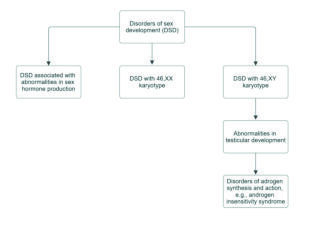
Complete androgen insensitivity syndrome (CAIS; also known as Morris syndrome) is a rare disorder associated with mutations in the androgen receptor gene located on the X chromosome. Individuals with CAIS, despite having a male karyotype, usually identify as female and exhibit female external genitalia. Management of CAIS patients requires a complex, interdisciplinary approach involving specialists in clinical genetics, gynecology, endocrinology, psychiatry and psychology. The aim of this study is to present the case of a 40-year-old patient diagnosed with an X chromosome mutation, including diagnostic procedures as well as pharmacological and surgical management.
REFERENCES (10)
1.
Malczyk Ż, Kleszyk M, Jarzumbek A, Kluczewska E, Ziora K, Oświęcimska J. Complete Androgen Insensitivity Syndrome – case report. [Article in Polish]. Pediatr Pol. 2015;90(6):520–526. doi: 10.1016/j.pepo.2015.08.007.
2.
Grądzik A, Gorajek A, Kudan M, Osiejewska A, Mikut K. 46 XY, Female. Complete androgen insensitivity syndrome: a case report. J Educ Health Sport. 2022;12(7):883–889. doi: 10.12775/JEHS.2022.12.07.088.
3.
Liao K, Wang Y, Yi X. Complete androgen insensitivity syndrome in twins with discordant phenotypes: a case report and review of the literature. J Med Case Rep. 2025;19(1):113. doi: 10.1186/s13256-025-05139-9.
4.
Kula K, Słowikowska-Hilczer J. Zaburzenia determinacji i różnicowania płci. In: Gajewski P, Jaeschke R [ed.]. Interna Szczeklika 2025. Medycyna Praktyczna. Kraków 2025, https://premium.mp.pl/podreczn....
5.
Deeb A, Hughes IA. Inguinal hernia in female infants: a cue to check the sex chromosomes? BJU Int. 2005;96(3):401–403. doi: 10.1111/j.1464-410X.2005.05639.x.
6.
Petriczko E, Marcinkiewicz K, Słowikowska-Hilczer J, Horodnicka-Józwa A, Stecewicz I, et al. Partial androgen insensitivity syndrome – case report. [Article in Polish]. Pediatr Endocrinol. 2014;13(1):61–68. doi: 10.18544/EP-01.13.01.1478.
7.
Farah S, El Masri D, Hirbli K. Complete androgen insensitivity syndrome in a 13-year-old Lebanese child, reared as female, with bilateral inguinal hernia: a case report. J Med Case Rep. 2021;15(1):202. doi: 10.1186/s13256-021-02738-0.
8.
Pritsini F, Kanakis GA, Kyrgios I, Kotanidou EP, Litou E, Mouzaki K, et al. Psychological aspects of androgen insensitivity syndrome: two cases illustrating therapeutical challenges. Case Rep Endocrinol. 2017;2017:8313162. doi: 10.1155/2017/8313162.
9.
Kowalczyk K, Przyborowska M, Rybka A, Udongwo M, Pluta D, Urban A, et al. Am I a woman? A case of complete androgen insensitivity syndrome and systematic review. [Article in Polish]. Ginekol Perinatol Prakt. 2019;4(3):129–132.
10.
Ovidiu B, Marcu DR, Mischianu DLD, Poiana C, Diaconu CC, Bungau SG, et al. The challenges of androgen insensitivity syndrome. Arch Med Sci. 2021;18(4):881–889. doi: 10.5114/aoms/125584.
| eISSN: | 1734-025X |


The Medical University of Silesia in Katowice, as the Operator of the annales.sum.edu.pl website, processes personal data collected when visiting the website. The function of obtaining information about Users and their behavior is carried out by voluntarily entered information in forms, saving cookies in end devices, as well as by collecting web server logs, which are in the possession of the website Operator. Data, including cookies, are used to provide services in accordance with the Privacy policy.
You can consent to the processing of data for these purposes, refuse consent or access more detailed information.
You can consent to the processing of data for these purposes, refuse consent or access more detailed information.