Current issue
Accepted manuscript
About the Journal
Scientific Council
Editorial Board
Regulatory and archival policy
Code of publishing ethics
Publisher
Information about the processing of personal data in relation to cookies and newsletter subscription
Archive
For Authors
For Reviewers
Contact
Reviewers
Annals reviewers in 2025
Annals reviewers in 2024
Annals reviewers in 2023
Annals reviewers in 2022
Annals reviewers in 2021
Annals reviewers in 2020
Annals reviewers in 2019
Annals reviewers in 2018
Annals reviewers in 2017
Annals reviewers in 2016
Annals reviewers in 2015
Annals reviewers in 2014
Annals reviewers in 2013
Annals reviewers in 2012
Links
Sklep Wydawnictwa SUM
Biblioteka Główna SUM
Śląski Uniwersytet Medyczny w Katowicach
Privacy policy
Accessibility statement
Reviewers
Annals reviewers in 2025
Annals reviewers in 2024
Annals reviewers in 2023
Annals reviewers in 2022
Annals reviewers in 2021
Annals reviewers in 2020
Annals reviewers in 2019
Annals reviewers in 2018
Annals reviewers in 2017
Annals reviewers in 2016
Annals reviewers in 2015
Annals reviewers in 2014
Annals reviewers in 2013
Annals reviewers in 2012

Prevalence and clinical significance of deventilation syndrome (DVS) in patients receiving long-term home non-invasive ventilation: A questionnaire-based pilot study
1
Department of Lung Diseases and Tuberculosis, Faculty of Medical Sciences in Zabrze, Medical University of Silesia, Katowice, Poland
2
Doctoral School, Medical University of Silesia, Katowice, Poland
3
Department of Anaesthesiology and Intensive Care, Faculty of Medical Sciences in Zabrze, Medical University of Silesia, Katowice, Poland
4
Home Mechanical Ventilation Team, Vital Aire sp. z o.o, Poznan, Poland
5
2nd Department of Lung Diseases, Mazovian Center for Treatment of Lung Diseases and Tuberculosis, Otwock, Poland
6
Department of Internal Medicine, Pulmonary Diseases and Allergy, Medical University of Warsaw, Poland
7
Department of Anesthesiology and Intensive Care, Faculty of Medical Sciences in Katowice,
Medical University of Silesia, Katowice, Poland
8
Students' Scientific Club, Department of Lung Diseases and Tuberculosis, Faculty of Medical Sciences in Zabrze, Medical University of Silesia, Katowice, Poland
9
2nd Department of Lung Diseases, Lung Cancer and Internal Diseases, University Teaching Hospital, Bialystok, Poland
10
Department of Lung Diseases and Respiratory Failure with the Subunit of Noninvasive Ventilation and the Subunit of Sleep-Related Breathing Disorders, Kuyavian-Pomeranian Center of Pulmonology, Bydgoszcz, Poland
11
Division of Respirology, Critical Care and Sleep Medicine, College of Medicine, University of Saskatchewan, Saskatoon, SK, Canada
Corresponding author
Mikołaj Rycerski
Katedra i Klinika Chorób Płuc i Gruźlicy, ul. Koziołka 1, 41-803 Zabrze, tel. +48 32 373 22 35
Katedra i Klinika Chorób Płuc i Gruźlicy, ul. Koziołka 1, 41-803 Zabrze, tel. +48 32 373 22 35

KEYWORDS
deventilation syndromenon-invasive ventilationhome mechanical ventilationdyspnoeachronic respiratory failurechronic obstructive pulmonary disease
TOPICS
ABSTRACT
Introduction:
Deventilation syndrome (DVS), defined as increased dyspnoea after cessation of prolonged non-invasive ventilation (NIV), remains a diagnostic and therapeutic challenge. Knowledge of its pathophysiology, prevalence and treatment is limited. This study aimed to characterise patients receiving home NIV, determine DVS prevalence and explore associated factors.
Material and methods:
This nationwide questionnaire-based observational study included patients treated within a home NIV programme and their attending physicians. DVS was defined using criteria based on the modified Borg scale/visual analogue scale and oxygen saturation changes after mask removal. Clinical and ventilatory variables were compared between patients with and without DVS.
Results:
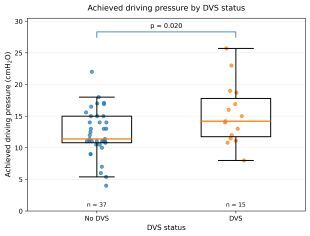
Sixty-five patients were included. DVS was identified in 21 patients (32.3%). Patients with DVS had greater dyspnoea intensity after NIV discontinuation and more often reported dyspnoea lasting more than one hour, immediate discomfort after mask removal and dyspnoea-related limitation of daily functioning. Achieved pressure support was higher in the DVS group than in patients without DVS (15.26 ± 4.78 vs 12.31 ± 3.68 cmH₂O; p=0.020). In exploratory logistic regression, higher achieved pressure support was associated with increased odds of DVS (OR 1.20 per 1 cmH₂O; 95% CI 1.02–1.41; p=0.031). BMI, Mallampati score, frailty, underlying diagnosis, NIV treatment duration and respiratory rate were not significantly associated with DVS.
Conclusions:
DVS affected approximately one-third of patients receiving home NIV and was associated with substantial post-ventilation symptoms. Higher achieved pressure support emerged as the main ventilatory correlate of DVS and requires further investigation.
Deventilation syndrome (DVS), defined as increased dyspnoea after cessation of prolonged non-invasive ventilation (NIV), remains a diagnostic and therapeutic challenge. Knowledge of its pathophysiology, prevalence and treatment is limited. This study aimed to characterise patients receiving home NIV, determine DVS prevalence and explore associated factors.
Material and methods:
This nationwide questionnaire-based observational study included patients treated within a home NIV programme and their attending physicians. DVS was defined using criteria based on the modified Borg scale/visual analogue scale and oxygen saturation changes after mask removal. Clinical and ventilatory variables were compared between patients with and without DVS.
Results:
Sixty-five patients were included. DVS was identified in 21 patients (32.3%). Patients with DVS had greater dyspnoea intensity after NIV discontinuation and more often reported dyspnoea lasting more than one hour, immediate discomfort after mask removal and dyspnoea-related limitation of daily functioning. Achieved pressure support was higher in the DVS group than in patients without DVS (15.26 ± 4.78 vs 12.31 ± 3.68 cmH₂O; p=0.020). In exploratory logistic regression, higher achieved pressure support was associated with increased odds of DVS (OR 1.20 per 1 cmH₂O; 95% CI 1.02–1.41; p=0.031). BMI, Mallampati score, frailty, underlying diagnosis, NIV treatment duration and respiratory rate were not significantly associated with DVS.
Conclusions:
DVS affected approximately one-third of patients receiving home NIV and was associated with substantial post-ventilation symptoms. Higher achieved pressure support emerged as the main ventilatory correlate of DVS and requires further investigation.
ACKNOWLEDGEMENTS
The authors thank all participating patients, physicians and home NIV centres for their contribution to the study.
FUNDING
The study was financed from statutory funds for academic year 2025/2026 no. BNW-1-053/N/6/K.
CONFLICT OF INTEREST
The authors declared no potential conflicts of interest with respect to the research, authorship, and/or publication of this article.
AUTHORS' CONTRIBUTIONS
Study design – A. Danel, S. Skoczyński; Data collection – A. Danel, M. Rycerski, S. Białka, A. Jarecka-Dobroń, J.Nasiłowski, K. Mendrala, M. Żak, O. Wybraniec, Ł. Minarowski, M. Czajkowska-Malinowska, R. Skomro, S. Skoczyński; Data interpretation – A. Danel, M. Rycerski, S. Skoczyński; Statistical analysis – A. Danel, M. Rycerski; Manuscript preparation – A. Danel, M. Rycerski, S. Skoczyński; Literature research – A. Danel, M. Rycerski
PEER REVIEW INFORMATION
Article has been screened for originality
REFERENCES (12)
1.
Ergan B, Oczkowski S, Rochwerg B, Carlucci A, Chatwin M, Clini E, et al. European Respiratory Society guidelines on long-term home non-invasive ventilation for management of COPD. Eur Respir J. 2019;54(3):1901003. doi: 10.1183/13993003.01003-2019.
2.
Macrea M, Oczkowski S, Rochwerg B, Branson RD, Celli B, Coleman JM 3rd, et al. Long-Term Noninvasive Ventilation in Chronic Stable Hypercapnic Chronic Obstructive Pulmonary Disease. An Official American Thoracic Society Clinical Practice Guideline. Am J Respir Crit Care Med. 2020;202(4):e74–e87. doi: 10.1164/rccm.202006-2382ST.
3.
Wollsching-Strobel M, Stannek K, Majorski DS, Magnet FS, Kroppen D, Berger MP, et al. Deventilation syndrome in COPD patients receiving long-term home noninvasive ventilation: A systematic scoping review. Respiration. 2024;103(2):60–69. doi: 10.1159/000535704.
4.
Schellenberg MD, Imach S, Iberl G, Kirchner M, Herth F, Trudzinski F. Clinical characterization and possible pathophysiological causes of the deventilation syndrome in COPD. Sci Rep. 2022;12(1):1099. doi: 10.1038/s41598-022-05118-w.
5.
Lüthgen M, Rüller S, Herzmann C. Characteristics of the deventilation syndrome in COPD patients treated with non-invasive ventilation: an explorative study. Respir Res. 2022;23(1):13. doi: 10.1186/s12931-022-01924-y.
6.
Elshof J, Oppersma E, Wisse JJ, Bladder G, Meijer PM, Torres A, et al. Deventilation syndrome in patients with chronic obstructive pulmonary disease using nocturnal noninvasive ventilation: What are the underlying mechanisms? Respiration. 2024;103(12):723–732. doi: 10.1159/000540780.
7.
O'Donnell DE, Revill SM, Webb KA. Dynamic hyperinflation and exercise intolerance in chronic obstructive pulmonary disease. Am J Respir Crit Care Med. 2001;164(5):770–777. doi: 10.1164/ajrccm.164.5.2012122.
8.
O'Donnell DE, Guenette JA, Maltais F, Webb KA. Decline of resting inspiratory capacity in COPD: the impact on breathing pattern, dyspnea, and ventilatory capacity during exercise. Chest. 2012;141(3):753–762. doi: 10.1378/chest.11-0787.
9.
Adler D, Perrig S, Takahashi H, Espa F, Rodenstein D, Pépin JL, et al. Polysomnography in stable COPD under non-invasive ventilation to reduce patient-ventilator asynchrony and morning breathlessness. Sleep Breath. 2012;16(4):1081–1090. doi: 10.1007/s11325-011-0605-y.
10.
Dreher M, Storre JH, Schmoor C, Windisch W. High-intensity versus low-intensity non-invasive ventilation in patients with stable hypercapnic COPD: a randomised crossover trial. Thorax. 2010;65(4):303–308. doi: 10.1136/thx.2009.124263.
11.
Köhnlein T, Windisch W, Köhler D, Drabik A, Geiseler J, Hartl S, et al. Non-invasive positive pressure ventilation for the treatment of severe stable chronic obstructive pulmonary disease: a prospective, multicentre, randomised, controlled clinical trial. Lancet Respir Med. 2014;2(9):698–705. doi: 10.1016/S2213-2600(14)70153-5.
12.
Jünger C, Reimann M, Krabbe L, Gaede KI, Lange C, Herzmann C, et al. Non-invasive ventilation with pursed lips breathing mode for patients with COPD and hypercapnic respiratory failure: A retrospective analysis. PLoS One. 2020;15(9):e0238619. doi: 10.1371/journal.pone.0238619.
Share
RELATED ARTICLE
| eISSN: | 1734-025X |


The Medical University of Silesia in Katowice, as the Operator of the annales.sum.edu.pl website, processes personal data collected when visiting the website. The function of obtaining information about Users and their behavior is carried out by voluntarily entered information in forms, saving cookies in end devices, as well as by collecting web server logs, which are in the possession of the website Operator. Data, including cookies, are used to provide services in accordance with the Privacy policy.
You can consent to the processing of data for these purposes, refuse consent or access more detailed information.
You can consent to the processing of data for these purposes, refuse consent or access more detailed information.