Bieżący numer
Artykuły zaakceptowane
O czasopiśmie
Rada Naukowa
Kolegium Redakcyjne
Polityka prawno-archiwizacyjna
Kodeks etyki publikacyjnej
Wydawca
Informacja o przetwarzaniu danych osobowych w ramach plików cookies oraz subskrypcji newslettera
Archiwum
Dla autorów
Dla recenzentów
Kontakt
Recenzenci
Recenzenci rocznika 2025
Recenzenci rocznika 2024
Recenzenci rocznika 2023
Recenzenci rocznika 2022
Recenzenci rocznika 2021
Recenzenci rocznika 2020
Recenzenci rocznika 2019
Recenzenci rocznika 2018
Recenzenci rocznika 2017
Recenzenci rocznika 2016
Recenzenci rocznika 2015
Recenzenci rocznika 2014
Recenzenci rocznika 2013
Recenzenci rocznika 2012
Polecamy
Śląski Uniwersytet Medyczny w Katowicach
Sklep Wydawnictw SUM
Biblioteka Główna SUM
Polityka prywatności
Deklaracja dostępności
Recenzenci
Recenzenci rocznika 2025
Recenzenci rocznika 2024
Recenzenci rocznika 2023
Recenzenci rocznika 2022
Recenzenci rocznika 2021
Recenzenci rocznika 2020
Recenzenci rocznika 2019
Recenzenci rocznika 2018
Recenzenci rocznika 2017
Recenzenci rocznika 2016
Recenzenci rocznika 2015
Recenzenci rocznika 2014
Recenzenci rocznika 2013
Recenzenci rocznika 2012

Prevalence and clinical significance of deventilation syndrome (DVS) in patients receiving long-term home non-invasive ventilation: A questionnaire-based pilot study
1
Department of Lung Diseases and Tuberculosis, Faculty of Medical Sciences in Zabrze, Medical University of Silesia, Katowice, Poland
2
Doctoral School, Medical University of Silesia, Katowice, Poland
3
Department of Anaesthesiology and Intensive Care, Faculty of Medical Sciences in Zabrze, Medical University of Silesia, Katowice, Poland
4
Home Mechanical Ventilation Team, Vital Aire sp. z o.o, Poznan, Poland
5
2nd Department of Lung Diseases, Mazovian Center for Treatment of Lung Diseases and Tuberculosis, Otwock, Poland
6
Department of Internal Medicine, Pulmonary Diseases and Allergy, Medical University of Warsaw, Poland
7
Department of Anesthesiology and Intensive Care, Faculty of Medical Sciences in Katowice,
Medical University of Silesia, Katowice, Poland
8
Students' Scientific Club, Department of Lung Diseases and Tuberculosis, Faculty of Medical Sciences in Zabrze, Medical University of Silesia, Katowice, Poland
9
2nd Department of Lung Diseases, Lung Cancer and Internal Diseases, University Teaching Hospital, Bialystok, Poland
10
Department of Lung Diseases and Respiratory Failure with the Subunit of Noninvasive Ventilation and the Subunit of Sleep-Related Breathing Disorders, Kuyavian-Pomeranian Center of Pulmonology, Bydgoszcz, Poland
11
Division of Respirology, Critical Care and Sleep Medicine, College of Medicine, University of Saskatchewan, Saskatoon, SK, Canada
Autor do korespondencji
Mikołaj Rycerski
Katedra i Klinika Chorób Płuc i Gruźlicy, ul. Koziołka 1, 41-803 Zabrze, tel. +48 32 373 22 35
Katedra i Klinika Chorób Płuc i Gruźlicy, ul. Koziołka 1, 41-803 Zabrze, tel. +48 32 373 22 35

SŁOWA KLUCZOWE
deventilation syndromenon-invasive ventilationhome mechanical ventilationdyspnoeachronic respiratory failurechronic obstructive pulmonary disease
DZIEDZINY
STRESZCZENIE
Introduction:
Deventilation syndrome (DVS), defined as increased dyspnoea after cessation of prolonged non-invasive ventilation (NIV), remains a diagnostic and therapeutic challenge. Knowledge of its pathophysiology, prevalence and treatment is limited. This study aimed to characterise patients receiving home NIV, determine DVS prevalence and explore associated factors.
Material and methods:
This nationwide questionnaire-based observational study included patients treated within a home NIV programme and their attending physicians. DVS was defined using criteria based on the modified Borg scale/visual analogue scale and oxygen saturation changes after mask removal. Clinical and ventilatory variables were compared between patients with and without DVS.
Results:
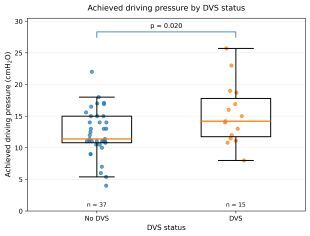
Sixty-five patients were included. DVS was identified in 21 patients (32.3%). Patients with DVS had greater dyspnoea intensity after NIV discontinuation and more often reported dyspnoea lasting more than one hour, immediate discomfort after mask removal and dyspnoea-related limitation of daily functioning. Achieved pressure support was higher in the DVS group than in patients without DVS (15.26 ± 4.78 vs 12.31 ± 3.68 cmH₂O; p=0.020). In exploratory logistic regression, higher achieved pressure support was associated with increased odds of DVS (OR 1.20 per 1 cmH₂O; 95% CI 1.02–1.41; p=0.031). BMI, Mallampati score, frailty, underlying diagnosis, NIV treatment duration and respiratory rate were not significantly associated with DVS.
Conclusions:
DVS affected approximately one-third of patients receiving home NIV and was associated with substantial post-ventilation symptoms. Higher achieved pressure support emerged as the main ventilatory correlate of DVS and requires further investigation.
Deventilation syndrome (DVS), defined as increased dyspnoea after cessation of prolonged non-invasive ventilation (NIV), remains a diagnostic and therapeutic challenge. Knowledge of its pathophysiology, prevalence and treatment is limited. This study aimed to characterise patients receiving home NIV, determine DVS prevalence and explore associated factors.
Material and methods:
This nationwide questionnaire-based observational study included patients treated within a home NIV programme and their attending physicians. DVS was defined using criteria based on the modified Borg scale/visual analogue scale and oxygen saturation changes after mask removal. Clinical and ventilatory variables were compared between patients with and without DVS.
Results:
Sixty-five patients were included. DVS was identified in 21 patients (32.3%). Patients with DVS had greater dyspnoea intensity after NIV discontinuation and more often reported dyspnoea lasting more than one hour, immediate discomfort after mask removal and dyspnoea-related limitation of daily functioning. Achieved pressure support was higher in the DVS group than in patients without DVS (15.26 ± 4.78 vs 12.31 ± 3.68 cmH₂O; p=0.020). In exploratory logistic regression, higher achieved pressure support was associated with increased odds of DVS (OR 1.20 per 1 cmH₂O; 95% CI 1.02–1.41; p=0.031). BMI, Mallampati score, frailty, underlying diagnosis, NIV treatment duration and respiratory rate were not significantly associated with DVS.
Conclusions:
DVS affected approximately one-third of patients receiving home NIV and was associated with substantial post-ventilation symptoms. Higher achieved pressure support emerged as the main ventilatory correlate of DVS and requires further investigation.
INFORMACJE O RECENZOWANIU
Sprawdzono w systemie antyplagiatowym
REFERENCJE (12)
1.
Ergan B, Oczkowski S, Rochwerg B, Carlucci A, Chatwin M, Clini E, et al. European Respiratory Society guidelines on long-term home non-invasive ventilation for management of COPD. Eur Respir J. 2019;54(3):1901003. doi: 10.1183/13993003.01003-2019.
2.
Macrea M, Oczkowski S, Rochwerg B, Branson RD, Celli B, Coleman JM 3rd, et al. Long-Term Noninvasive Ventilation in Chronic Stable Hypercapnic Chronic Obstructive Pulmonary Disease. An Official American Thoracic Society Clinical Practice Guideline. Am J Respir Crit Care Med. 2020;202(4):e74–e87. doi: 10.1164/rccm.202006-2382ST.
3.
Wollsching-Strobel M, Stannek K, Majorski DS, Magnet FS, Kroppen D, Berger MP, et al. Deventilation syndrome in COPD patients receiving long-term home noninvasive ventilation: A systematic scoping review. Respiration. 2024;103(2):60–69. doi: 10.1159/000535704.
4.
Schellenberg MD, Imach S, Iberl G, Kirchner M, Herth F, Trudzinski F. Clinical characterization and possible pathophysiological causes of the deventilation syndrome in COPD. Sci Rep. 2022;12(1):1099. doi: 10.1038/s41598-022-05118-w.
5.
Lüthgen M, Rüller S, Herzmann C. Characteristics of the deventilation syndrome in COPD patients treated with non-invasive ventilation: an explorative study. Respir Res. 2022;23(1):13. doi: 10.1186/s12931-022-01924-y.
6.
Elshof J, Oppersma E, Wisse JJ, Bladder G, Meijer PM, Torres A, et al. Deventilation syndrome in patients with chronic obstructive pulmonary disease using nocturnal noninvasive ventilation: What are the underlying mechanisms? Respiration. 2024;103(12):723–732. doi: 10.1159/000540780.
7.
O'Donnell DE, Revill SM, Webb KA. Dynamic hyperinflation and exercise intolerance in chronic obstructive pulmonary disease. Am J Respir Crit Care Med. 2001;164(5):770–777. doi: 10.1164/ajrccm.164.5.2012122.
8.
O'Donnell DE, Guenette JA, Maltais F, Webb KA. Decline of resting inspiratory capacity in COPD: the impact on breathing pattern, dyspnea, and ventilatory capacity during exercise. Chest. 2012;141(3):753–762. doi: 10.1378/chest.11-0787.
9.
Adler D, Perrig S, Takahashi H, Espa F, Rodenstein D, Pépin JL, et al. Polysomnography in stable COPD under non-invasive ventilation to reduce patient-ventilator asynchrony and morning breathlessness. Sleep Breath. 2012;16(4):1081–1090. doi: 10.1007/s11325-011-0605-y.
10.
Dreher M, Storre JH, Schmoor C, Windisch W. High-intensity versus low-intensity non-invasive ventilation in patients with stable hypercapnic COPD: a randomised crossover trial. Thorax. 2010;65(4):303–308. doi: 10.1136/thx.2009.124263.
11.
Köhnlein T, Windisch W, Köhler D, Drabik A, Geiseler J, Hartl S, et al. Non-invasive positive pressure ventilation for the treatment of severe stable chronic obstructive pulmonary disease: a prospective, multicentre, randomised, controlled clinical trial. Lancet Respir Med. 2014;2(9):698–705. doi: 10.1016/S2213-2600(14)70153-5.
12.
Jünger C, Reimann M, Krabbe L, Gaede KI, Lange C, Herzmann C, et al. Non-invasive ventilation with pursed lips breathing mode for patients with COPD and hypercapnic respiratory failure: A retrospective analysis. PLoS One. 2020;15(9):e0238619. doi: 10.1371/journal.pone.0238619.
Udostępnij
ARTYKUŁ POWIĄZANY
| eISSN: | 1734-025X |


Śląski Uniwersytet Medyczny w Katowicach, jako Operator Serwisu annales.sum.edu.pl, przetwarza dane osobowe zbierane podczas odwiedzania Serwisu. Realizacja funkcji pozyskiwania informacji o Użytkownikach i ich zachowaniu odbywa się poprzez dobrowolnie wprowadzone w formularzach informacje, zapisywanie w urządzeniach końcowych plików cookies (tzw. ciasteczka), a także poprzez gromadzenie logów serwera www, będącego w posiadaniu Operatora Serwisu. Dane, w tym pliki cookies, wykorzystywane są w celu realizacji usług zgodnie z Polityką prywatności.
Możesz wyrazić zgodę na przetwarzanie danych w tych celach, odmówić zgody lub uzyskać dostęp do bardziej szczegółowych informacji.
Możesz wyrazić zgodę na przetwarzanie danych w tych celach, odmówić zgody lub uzyskać dostęp do bardziej szczegółowych informacji.