Current issue
Accepted manuscript
About the Journal
Scientific Council
Editorial Board
Regulatory and archival policy
Code of publishing ethics
Publisher
Information about the processing of personal data in relation to cookies and newsletter subscription
Archive
For Authors
For Reviewers
Contact
Reviewers
Annals reviewers in 2025
Annals reviewers in 2024
Annals reviewers in 2023
Annals reviewers in 2022
Annals reviewers in 2021
Annals reviewers in 2020
Annals reviewers in 2019
Annals reviewers in 2018
Annals reviewers in 2017
Annals reviewers in 2016
Annals reviewers in 2015
Annals reviewers in 2014
Annals reviewers in 2013
Annals reviewers in 2012
Links
Sklep Wydawnictwa SUM
Biblioteka Główna SUM
Śląski Uniwersytet Medyczny w Katowicach
Privacy policy
Accessibility statement
Reviewers
Annals reviewers in 2025
Annals reviewers in 2024
Annals reviewers in 2023
Annals reviewers in 2022
Annals reviewers in 2021
Annals reviewers in 2020
Annals reviewers in 2019
Annals reviewers in 2018
Annals reviewers in 2017
Annals reviewers in 2016
Annals reviewers in 2015
Annals reviewers in 2014
Annals reviewers in 2013
Annals reviewers in 2012

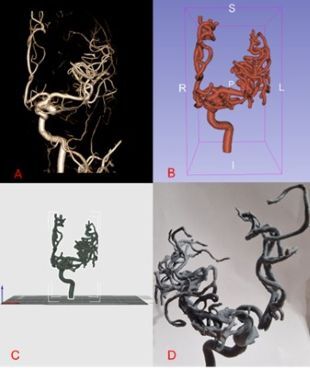
Patient-specific three-dimensional printing of cerebral vasculature from digital subtraction angiography for aneurysm surgery: A practical workflow and preliminary clinical experience

1
Department of Neurosurgery, Faculty of Medical Sciences in Katowice, Medical University of Silesia, Katowice, Poland, University Clinical Center named after Prof. Kornel Gibiński
Corresponding author
Marcin Setlak
Klinika Neurochirurgii, Wydział Nauk Medycznych w Katowicach ŚUM, ul. Medyków 14, 40-752 Katowice
Klinika Neurochirurgii, Wydział Nauk Medycznych w Katowicach ŚUM, ul. Medyków 14, 40-752 Katowice

KEYWORDS
intracranial aneurysmpatient-specific modelneurosurgerydigital subtraction angiographysurgical planning3D printing of cerebral vessels
TOPICS
ABSTRACT
Introduction:
Patient-specific three-dimensional (3D) printing has become an increasingly useful adjunct in neurosurgery, particularly in situations where precise understanding of spatial vascular anatomy is important for treatment planning. In intracranial aneurysm surgery, physical models may complement standard imaging by providing a tangible representation of the aneurysm and its relationship to the parent vessel and adjacent branches.
Material and methods:
Source imaging data were obtained from routine digital subtraction angiography with rotational acquisition and 3D reconstruction. Selected datasets were processed in 3D Slicer, where vascular segmentation, removal of nonessential distal branches, island removal, surface smoothing, and STL export were performed. The final models were prepared for printing in Bambu Studio and printed on a Bambu Lab A1 mini printer using PLA filament and tree supports optimized for thin vascular structures.
Results:
The described workflow enabled generation of patient-specific physical vascular models reproducing the aneurysm and the selected parent vessel anatomy relevant to surgical planning. The models were found to be useful as a supplementary aid in preoperative anatomical assessment, improving spatial understanding of aneurysm configuration and branch relationships within the selected vascular region of interest.
Conclusions:
Patient-specific 3D printing of cerebral vasculature from digital subtraction angiography is feasible and can be implemented in routine practice using accessible software and desktop printing tools. Such models may serve as a useful adjunct in preoperative assessment, team discussion, and surgical education. Further evaluation in larger clinical series is warranted.
Patient-specific three-dimensional (3D) printing has become an increasingly useful adjunct in neurosurgery, particularly in situations where precise understanding of spatial vascular anatomy is important for treatment planning. In intracranial aneurysm surgery, physical models may complement standard imaging by providing a tangible representation of the aneurysm and its relationship to the parent vessel and adjacent branches.
Material and methods:
Source imaging data were obtained from routine digital subtraction angiography with rotational acquisition and 3D reconstruction. Selected datasets were processed in 3D Slicer, where vascular segmentation, removal of nonessential distal branches, island removal, surface smoothing, and STL export were performed. The final models were prepared for printing in Bambu Studio and printed on a Bambu Lab A1 mini printer using PLA filament and tree supports optimized for thin vascular structures.
Results:
The described workflow enabled generation of patient-specific physical vascular models reproducing the aneurysm and the selected parent vessel anatomy relevant to surgical planning. The models were found to be useful as a supplementary aid in preoperative anatomical assessment, improving spatial understanding of aneurysm configuration and branch relationships within the selected vascular region of interest.
Conclusions:
Patient-specific 3D printing of cerebral vasculature from digital subtraction angiography is feasible and can be implemented in routine practice using accessible software and desktop printing tools. Such models may serve as a useful adjunct in preoperative assessment, team discussion, and surgical education. Further evaluation in larger clinical series is warranted.
Use of AI tools statement: ChatGPT (OpenAI) was used as an auxiliary tool for language editing and stylistic improvement of the manuscript text. All scientific content, literature selection, interpretation of data, and final approval of the manuscript were performed by the author.
REFERENCES (16)
1.
Randazzo M, Pisapia JM, Singh N, Thawani JP. 3D printing in neurosurgery: A systematic review. Surg Neurol Int. 2016;7(Suppl 33):S801–S809. doi: 10.4103/2152-7806.194059.
2.
Vakharia VN, Vakharia NN, Hill CS. Review of 3-Dimensional Printing on Cranial Neurosurgery Simulation Training. World Neurosurg. 2016;88:188–198. doi: 10.1016/j.wneu.2015.12.031.
3.
Chappell ET, Moure FC, Good MC. Comparison of computed tomographic angiography with digital subtraction angiography in the diagnosis of cerebral aneurysms: a meta-analysis. Neurosurgery. 2003;52(3):624–631; discussion 630–631. doi: 10.1227/01.neu.0000047895.82857.eb.
4.
Lu L, Zhang LJ, Poon CS, Wu SY, Zhou CS, Luo S, et al. Digital subtraction CT angiography for detection of intracranial aneurysms: comparison with three-dimensional digital subtraction angiography. Radiology. 2012;262(2):605–612. doi: 10.1148/radiol.11110486.
5.
Chen W, Xing W, Peng Y, He Z, Wang C, Wang Q. Diagnosis and Treatment of Intracranial Aneurysms with 320-Detector Row Volumetric Computed Tomography Angiography. World Neurosurg. 2016;91:347–356. doi: 10.1016/j.wneu.2016.04.046.
6.
Khan IS, Kelly PD, Singer RJ. Prototyping of cerebral vasculature physical models. Surg Neurol Int. 2014;5:11. doi: 10.4103/2152-7806.125858.
7.
Wang JL, Yuan ZG, Qian GL, Bao WQ, Jin GL. 3D printing of intracranial aneurysm based on intracranial digital subtraction angiography and its clinical application. Medicine. 2018;97(24):e11103. doi: 10.1097/MD.0000000000011103.
8.
Haruma J, Sugiu K, Hoshika M, Hiramatsu M, Hishikawa T, Murai S, et al. A New Method of Intracranial Aneurysm Modeling for Stereolithography Apparatus 3D Printer: The "Wall-Carving Technique" Using Digital Imaging and Communications in Medicine Data. World Neurosurg. 2022;159:e113–e119. doi: 10.1016/j.wneu.2021.12.018.
9.
Anderson JR, Thompson WL, Alkattan AK, Diaz O, Klucznik R, Zhang YJ, et al. Three-dimensional printing of anatomically accurate, patient specific intracranial aneurysm models. J Neurointerv Surg. 2016;8(5):517–520. doi: 10.1136/neurintsurg-2015-011686.
10.
Frölich AM, Spallek J, Brehmer L, Buhk JH, Krause D, Fiehler J, et al. 3D Printing of Intracranial Aneurysms Using Fused Deposition Modeling Offers Highly Accurate Replications. AJNR Am J Neuroradiol. 2016;37(1):120–124. doi: 10.3174/ajnr.A4486.
11.
Joseph FJ, Vanluchene HER, Goldberg J, Bervini D. 3D-Printed Head Model in Patient's Education for Micro-Neurosurgical Aneurysm Clipping Procedures. World Neurosurg. 2023;175:e1069–e1074. doi: 10.1016/j.wneu.2023.04.070.
12.
Kim PS, Choi CH, Han IH, Lee JH, Choi HJ, Lee JI. Obtaining Informed Consent Using Patient Specific 3D Printing Cerebral Aneurysm Model. J Korean Neurosurg Soc. 2019;62(4):398–404. doi: 10.3340/jkns.2019.0092.
13.
Blohm JE, Salinas PA, Avila MJ, Barber SR, Weinand ME, Dumont TM. Three-Dimensional Printing in Neurosurgery Residency Training: A Systematic Review of the Literature. World Neurosurg. 2022;161:111–122. doi: 10.1016/j.wneu.2021.10.069.
14.
Park CK. 3D-Printed Disease Models for Neurosurgical Planning, Simulation, and Training. J Korean Neurosurg Soc. 2022;65(4):489–498. doi: 10.3340/jkns.2021.0235.
15.
Mantilla DE, Ferrara R, Ortiz AF, Vera DD, Nicoud F, Costalat V. Validation of three-dimensional printed models of intracranial aneurysms. Interv Neuroradiol. 2024;30(5):712–719. doi: 10.1177/15910199221143254.
16.
Faraj MK, Hoz SS, Mohammad AJ. The use of three-dimensional anatomical patient-specific printed models in surgical clipping of intracranial aneurysm: A pilot study. Surg Neurol Int. 2020;11:381. doi: 10.25259/SNI_361_2020.
| eISSN: | 1734-025X |


The Medical University of Silesia in Katowice, as the Operator of the annales.sum.edu.pl website, processes personal data collected when visiting the website. The function of obtaining information about Users and their behavior is carried out by voluntarily entered information in forms, saving cookies in end devices, as well as by collecting web server logs, which are in the possession of the website Operator. Data, including cookies, are used to provide services in accordance with the Privacy policy.
You can consent to the processing of data for these purposes, refuse consent or access more detailed information.
You can consent to the processing of data for these purposes, refuse consent or access more detailed information.