Current issue
Accepted manuscript
About the Journal
Scientific Council
Editorial Board
Regulatory and archival policy
Code of publishing ethics
Publisher
Information about the processing of personal data in relation to cookies and newsletter subscription
Archive
For Authors
For Reviewers
Contact
Reviewers
Annals reviewers in 2025
Annals reviewers in 2024
Annals reviewers in 2023
Annals reviewers in 2022
Annals reviewers in 2021
Annals reviewers in 2020
Annals reviewers in 2019
Annals reviewers in 2018
Annals reviewers in 2017
Annals reviewers in 2016
Annals reviewers in 2015
Annals reviewers in 2014
Annals reviewers in 2013
Annals reviewers in 2012
Links
Sklep Wydawnictwa SUM
Biblioteka Główna SUM
Śląski Uniwersytet Medyczny w Katowicach
Privacy policy
Accessibility statement
Reviewers
Annals reviewers in 2025
Annals reviewers in 2024
Annals reviewers in 2023
Annals reviewers in 2022
Annals reviewers in 2021
Annals reviewers in 2020
Annals reviewers in 2019
Annals reviewers in 2018
Annals reviewers in 2017
Annals reviewers in 2016
Annals reviewers in 2015
Annals reviewers in 2014
Annals reviewers in 2013
Annals reviewers in 2012

Life satisfaction and the severity of symptoms of depression and anxiety among people who practice Brazilian jiu-jitsu (BJJ) and mixed martial arts (MMA)
1
Department of Psychiatry, Faculty of Medical Sciences in Zabrze, Medical University of Silesia, Katowice, Poland
Corresponding author
Katarzyna Folga-Cytrycka
Oddział Kliniczny Psychiatrii, Wydział Nauk Medycznych w Zabrzu ŚUM, ul. Pyskowicka 49, 42-612 Tarnowskie Góry
Oddział Kliniczny Psychiatrii, Wydział Nauk Medycznych w Zabrzu ŚUM, ul. Pyskowicka 49, 42-612 Tarnowskie Góry
Ann. Acad. Med. Siles. 2026;80:63-70

KEYWORDS
TOPICS
ABSTRACT
Introduction:
Brazilian jiu-jitsu (BJJ) and mixed martial arts (MMA) can provide the appropriate amount of movement to prevent mental disorders. The aim of the study was to compare individuals training in BJJ, MMA, and both of these disciplines in terms of the occurrence of depressive and anxiety symptoms and level of life satisfaction.
Material and methods:
The study involved 229 people (147 men – 64.2%, and 82 women – 35.8%) aged 14 to 47 years, with an average age of 29 ± 7.897. Out of all respondents, 62.4% trained in BJJ, 16.2% in MMA, and 21.4% in both sports. To assess the subjects’ parameters, the following scales were used: the Satisfaction With Life Scale (SWLS), the Hospital Anxiety and Depression Scale (HADS), and the author’s original scale of sociodemographic data.
Results:
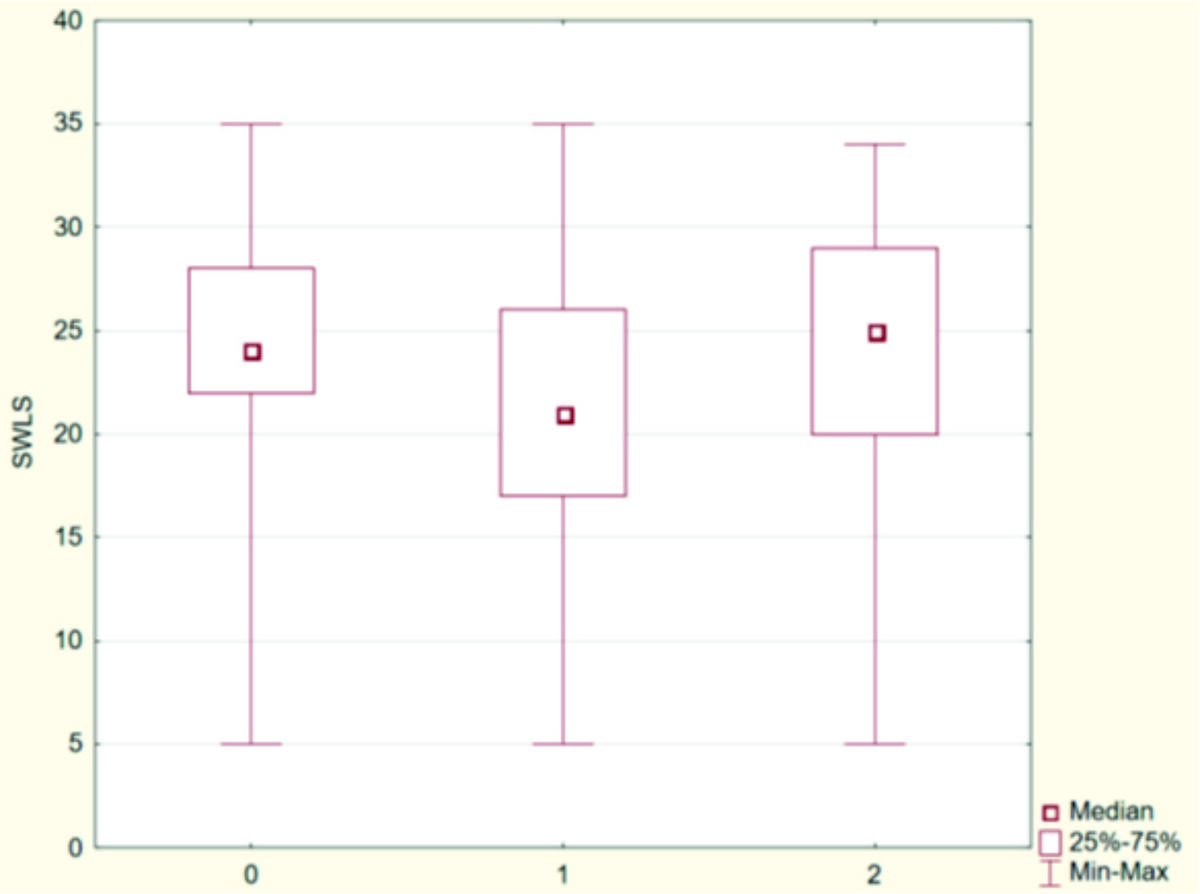
The results from the SWLS showed a significant difference in life satisfaction between groups practicing different sport disciplines. People practicing BJJ scored 24 ± 5.952 points, those practicing MMA scored 21 ± 6.727 points, and people practicing both disciplines scored 25 ± 6.704 points. The results were statistically significant (p = 0.029). In the HADS-A subscale, women achieved statistically significantly higher results than men (p = 0.000). Moreover, the age of the respondents and the length of training in years showed statistically significant positive correlations with the results of the HADS-A scale.
Conclusions:
People practicing only MMA rated their life satisfaction lower than those training both disciplines or only BJJ. A longer period of training and older age were associated with less severe anxiety symptoms. Women scored higher on the anxiety scale than men.
Brazilian jiu-jitsu (BJJ) and mixed martial arts (MMA) can provide the appropriate amount of movement to prevent mental disorders. The aim of the study was to compare individuals training in BJJ, MMA, and both of these disciplines in terms of the occurrence of depressive and anxiety symptoms and level of life satisfaction.
Material and methods:
The study involved 229 people (147 men – 64.2%, and 82 women – 35.8%) aged 14 to 47 years, with an average age of 29 ± 7.897. Out of all respondents, 62.4% trained in BJJ, 16.2% in MMA, and 21.4% in both sports. To assess the subjects’ parameters, the following scales were used: the Satisfaction With Life Scale (SWLS), the Hospital Anxiety and Depression Scale (HADS), and the author’s original scale of sociodemographic data.
Results:
The results from the SWLS showed a significant difference in life satisfaction between groups practicing different sport disciplines. People practicing BJJ scored 24 ± 5.952 points, those practicing MMA scored 21 ± 6.727 points, and people practicing both disciplines scored 25 ± 6.704 points. The results were statistically significant (p = 0.029). In the HADS-A subscale, women achieved statistically significantly higher results than men (p = 0.000). Moreover, the age of the respondents and the length of training in years showed statistically significant positive correlations with the results of the HADS-A scale.
Conclusions:
People practicing only MMA rated their life satisfaction lower than those training both disciplines or only BJJ. A longer period of training and older age were associated with less severe anxiety symptoms. Women scored higher on the anxiety scale than men.
FUNDING
The research did not receive any specific grant from any funding agency in the public, commercial, or nonprofit sectors.
CONFLICT OF INTEREST
The authors declare that there is no conflict of interest with respect to the research, authorship, and/or publication of this article.
REFERENCES (34)
1.
Reusing HM. The language of martial arts: The transformative potential of Brazilian jiu-jitsu through the lens of depth psychology. ProQuest LLC. Ann Arbor, MI, 2014.
2.
Spencer DC. Habit(us), body techniques and body callusing: An ethnography of mixed martial arts. Body Soc. 2009;15(4):119–143. doi: 10.1177/1357034X09347224.
4.
GBD 2019 Mental Disorders Collaborators. Global, regional, and national burden of 12 mental disorders in 204 countries and territories, 1990-2019: a systematic analysis for the Global Burden of Disease Study 2019. Lancet Psychiatry. 2022;9(2):137–150. doi: 10.1016/S2215-0366(21)00395-3.
5.
Wytyczne WHO dotyczące aktywności fizycznej i siedzącego trybu życia: omówienie [pdf]. Kopenhaga: Biuro Regionalne WHO na Europę; 2021. Licencja: CC BY-NC-SA 3.0 IGO; https://iris.who.int/bitstream....
6.
Imboden C, Claussen MC, Seifritz E, Gerber M. The Importance of Physical Activity for Mental Health. [Article in German]. Praxis (Bern 1994). 2022;110(4):186–191. doi: 10.1024/1661-8157/a003831.
7.
Lubecka B, Lubecki M, Kasperczyk J, Jośko-Ochojska J, Pudlo R. Risk Modifying Factors of Anxiety and Depressive Disorders, Using the Example of a Population Study in the Żywiec District. Int J Environ Res Public Health. 2021;18(19):10248. doi: 10.3390/ijerph181910248.
8.
An HY, Chen W, Wang CW, Yang HF, Huang WT, Fan SY. The Relationships between Physical Activity and Life Satisfaction and Happiness among Young, Middle-Aged, and Older Adults. Int J Environ Res Public Health. 2020;17(13):4817. doi: 10.3390/ijerph17134817.
9.
Maher JP, Pincus AL, Ram N, Conroy DE. Daily physical activity and life satisfaction across adulthood. Dev Psychol. 2015;51(10):1407–1419. doi: 10.1037/dev0000037.
10.
Cooney GM, Dwan K, Greig CA, Lawlor DA, Rimer J, Waugh FR, et al. Exercise for depression. Cochrane Database Syst Rev. 2013;2013(9):CD004366. doi: 10.1002/14651858.CD004366.pub6.
11.
Singh B, Olds T, Curtis R, Dumuid D, Virgara R, Watson A, et al. Effectiveness of physical activity interventions for improving depression, anxiety and distress: an overview of systematic reviews. Br J Sports Med. 2023;57(18):1203–1209. doi: 10.1136/bjsports-2022-106195.
12.
Saeed SA, Antonacci DJ, Bloch RM. Exercise, yoga, and meditation for depressive and anxiety disorders. Am Fam Physician. 2010;81(8):981–986.
13.
Willing AE, Girling SA, Deichert R, Wood-Deichert R, Gonzalez J, Hernandez D, et al. Brazilian Jiu Jitsu Training for US Service Members and Veterans with Symptoms of PTSD. Mil Med. 2019;184(11–12):e626–e631. doi: 10.1093/milmed/usz074.
14.
Blomqvist Mickelsson T. Modern unexplored martial arts – what can mixed martial arts and Brazilian Jiu-Jitsu do for youth development? Eur J Sport Sci. 2020;20(3):386–393. doi: 10.1080/17461391.2019.1629180.
15.
Diener E, Emmons RA, Larson RJ, Griffin S. Skala satysfakcji z życia – SWLS. In: Z. Juczyński [adapt.]. Narzędzia pomiaru w promocji i psychologii zdrowia. Pracownia Testów Psychologicznych Polskiego Towarzystwa Psychologicznego. Warszawa 2001, p. 134–138.
16.
Karakuła H, Grzywa A, Śpila B, Baszak J, Gieroba A, Kosikowski W, et al. Zastosowanie Skali Lęku i Depresji – HADS w chorobach psychosomatycznych. Psychiatr Pol. 1996;30(4):653–668.
17.
Bandelow B, Michaelis S. Epidemiology of anxiety disorders in the 21st century. Dialogues Clin Neurosci. 2015;17(3):327–335. doi: 10.31887/DCNS.2015.17.3/bbandelow.
18.
Layton C. Anxiety in black-belt and nonblack-belt traditional karateka. Percept Mot Skills. 1990;71(3 Pt 1):905–906. doi: 10.2466/PMS.71.7.905-906.
19.
Fernández MM, Brito CJ, Miarka B, Díaz-de-Durana AL. Anxiety and Emotional Intelligence: Comparisons Between Combat Sports, Gender and Levels Using the Trait Meta-Mood Scale and the Inventory of Situations and Anxiety Response. Front Psychol. 2020;11:130. doi: 10.3389/fpsyg.2020.00130. Erratum in: Front Psychol. 2020;11:889. doi: 10.3389/fpsyg.2020.00889.
20.
Smith T. Competition trait anxiety in youth sport: differences according to age, sex, race and playing status. Percept Mot Skills. 1983;57(3 Pt 2):1235–1238. doi: 10.2466/pms.1983.57.3f.1235.
21.
Imboden C, Gerber M, Beck J, Holsboer-Trachsler E, Pühse U, Hatzinger M. Aerobic exercise or stretching as add-on to inpatient treatment of depression: Similar antidepressant effects on depressive symptoms and larger effects on working memory for aerobic exercise alone. J Affect Disord. 2020;276:866–876. doi: 10.1016/j.jad.2020.07.052.
22.
Kvam S, Kleppe CL, Nordhus IH, Hovland A. Exercise as a treatment for depression: A meta-analysis. J Affect Disord. 2016;202:67–86. doi: 10.1016/j.jad.2016.03.063.
23.
Chekroud SR, Gueorguieva R, Zheutlin AB, Paulus M, Krumholz HM, Krystal JH, et al. Association between physical exercise and mental health in 1·2 million individuals in the USA between 2011 and 2015: a cross-sectional study. Lancet Psychiatry. 2018;5(9):739–746. doi: 10.1016/S2215-0366(18)30227-X.
24.
Wypych-Ślusarska A, Majer N, Krupa-Kotara K, Niewiadomska E. Active and Happy? Physical Activity and Life Satisfaction among Young Educated Women. Int J Environ Res Public Health. 2023;20(4):3145. doi: 10.3390/ijerph20043145.
25.
Eime R, Harvey J, Payne W. Dose-response of women’s health-related quality of life (HRQoL) and life satisfaction to physical activity. J Phys Act Health. 2014;11(2):330–338. doi: 10.1123/jpah.2012-0073.
26.
Potoczny W, Herzog-Krzywoszanska R, Krzywoszanski L. Self-Control and Emotion Regulation Mediate the Impact of Karate Training on Satisfaction With Life. Front Behav Neurosci. 2022;15:802564. doi: 10.3389/fnbeh.2021.802564.
27.
Kotarska K, Nowak L, Szark-Eckardt M, Nowak M. Selected Healthy Behaviors and Quality of Life in People Who Practice Combat Sports and Martial Arts. Int J Environ Res Public Health. 2019;16(5):875. doi: 10.3390/ijerph16050875.
28.
Hunzinger KJ, Caccese JB, Mannix R, Meehan WP 3rd, Swanik CB, Buckley TA. Contact or Collision Sport History, Repetitive Neurotrauma, and Patient-Reported Outcomes in Early to Midadulthood. J Athl Train. 2023;58(11–12):952–961. doi: 10.4085/1062-6050-0017.23.
29.
Vaquero Solís M, Sánchez-Miguel PA, Tapia Serrano MÁ, Pulido JJ, Iglesias Gallego D. Physical Activity as a Regulatory Variable between Adolescents’ Motivational Processes and Satisfaction with Life. Int J Environ Res Public Health. 2019;16(15):2765. doi: 10.3390/ijerph16152765.
30.
Villafaina S, Tapia-Serrano MÁ, Vaquero-Solís M, León-Llamas JL, Sánchez-Miguel PA. The Role of Physical Activity in the Relationship between Satisfaction with Life and Health-Related Quality of Life in School-Age Adolescents. Behav Sci (Basel). 2021;11(9):121. doi: 10.3390/bs11090121.
31.
McMahon EM, Corcoran P, O’Regan G, Keeley H, Cannon M, Carli V, et al. Physical activity in European adolescents and associations with anxiety, depression and well-being. Eur Child Adolesc Psychiatry. 2017;26(1):111–122. doi: 10.1007/s00787-016-0875-9.
32.
Dunn AL, Trivedi MH, Kampert JB, Clark CG, Chambliss HO. Exercise treatment for depression: Efficacy and dose response. Am J Prev Med. 2005;28(1):1–8. doi: 10.1016/j.amepre.2004.09.003.
33.
Rassovsky Y, Harwood A, Zagoory-Sharon O, Feldman R. Martial arts increase oxytocin production. Sci Rep. 2019;9(1):12980. doi: 10.1038/s41598-019-49620-0.
34.
Pluhar E, McCracken C, Griffith KL, Christino MA, Sugimoto D, Meehan WP 3rd. Team Sport Athletes May Be Less Likely To Suffer Anxiety or Depression than Individual Sport Athletes. J Sports Sci Med. 2019;18(3):490–496.
| eISSN: | 1734-025X |


The Medical University of Silesia in Katowice, as the Operator of the annales.sum.edu.pl website, processes personal data collected when visiting the website. The function of obtaining information about Users and their behavior is carried out by voluntarily entered information in forms, saving cookies in end devices, as well as by collecting web server logs, which are in the possession of the website Operator. Data, including cookies, are used to provide services in accordance with the Privacy policy.
You can consent to the processing of data for these purposes, refuse consent or access more detailed information.
You can consent to the processing of data for these purposes, refuse consent or access more detailed information.