Bieżący numer
Artykuły zaakceptowane
O czasopiśmie
Rada Naukowa
Kolegium Redakcyjne
Polityka prawno-archiwizacyjna
Kodeks etyki publikacyjnej
Wydawca
Informacja o przetwarzaniu danych osobowych w ramach plików cookies oraz subskrypcji newslettera
Archiwum
Dla autorów
Dla recenzentów
Kontakt
Recenzenci
Recenzenci rocznika 2025
Recenzenci rocznika 2024
Recenzenci rocznika 2023
Recenzenci rocznika 2022
Recenzenci rocznika 2021
Recenzenci rocznika 2020
Recenzenci rocznika 2019
Recenzenci rocznika 2018
Recenzenci rocznika 2017
Recenzenci rocznika 2016
Recenzenci rocznika 2015
Recenzenci rocznika 2014
Recenzenci rocznika 2013
Recenzenci rocznika 2012
Polecamy
Śląski Uniwersytet Medyczny w Katowicach
Sklep Wydawnictw SUM
Biblioteka Główna SUM
Polityka prywatności
Deklaracja dostępności
Recenzenci
Recenzenci rocznika 2025
Recenzenci rocznika 2024
Recenzenci rocznika 2023
Recenzenci rocznika 2022
Recenzenci rocznika 2021
Recenzenci rocznika 2020
Recenzenci rocznika 2019
Recenzenci rocznika 2018
Recenzenci rocznika 2017
Recenzenci rocznika 2016
Recenzenci rocznika 2015
Recenzenci rocznika 2014
Recenzenci rocznika 2013
Recenzenci rocznika 2012

Ocena porównawcza poziomu satysfakcji z życia oraz występowania objawów depresyjnych i lękowych u osób trenujących brazylijskie jiu-jitsu (BJJ) oraz mieszane sztuki walki (MMA)
1
Department of Psychiatry, Faculty of Medical Sciences in Zabrze, Medical University of Silesia, Katowice, Poland
Autor do korespondencji
Katarzyna Folga-Cytrycka
Oddział Kliniczny Psychiatrii, Wydział Nauk Medycznych w Zabrzu ŚUM, ul. Pyskowicka 49, 42-612 Tarnowskie Góry
Oddział Kliniczny Psychiatrii, Wydział Nauk Medycznych w Zabrzu ŚUM, ul. Pyskowicka 49, 42-612 Tarnowskie Góry
Ann. Acad. Med. Siles. 2026;80:63-70

SŁOWA KLUCZOWE
DZIEDZINY
STRESZCZENIE
Wstęp:
Brazylijskie jiu-jitsu (BJJ) oraz mieszane sztuki walki (mixed martial arts – MMA) mogą zapewnić odpowiednią ilość ruchu, zapobiegając zaburzeniom psychicznym. Celem pracy było porównanie osób trenujących BJJ, MMA lub obie te dyscypliny pod względem występowania objawów depresji, lęku oraz poziomu satysfakcji z życia.
Materiał i metody:
W badaniu wzięło udział 229 osób (147 mężczyzn – 64,2%, i 82 kobiety – 35,8%) w wieku od 14 do 47 lat; średnia wieku wynosiła 29 ± 7,897 roku. BJJ trenowało 62,4% ankietowanych, MMA 16,2%, oba sporty 21,4%. Do oceny parametrów badanych użyto Skali satysfakcji z życia (Satisfaction With Life Scale – SWLS), Szpitalnej skali lęku i depresji (Hospital Anxiety and Depression Scale – HADS) oraz danych socjodemograficznych.
Wyniki:
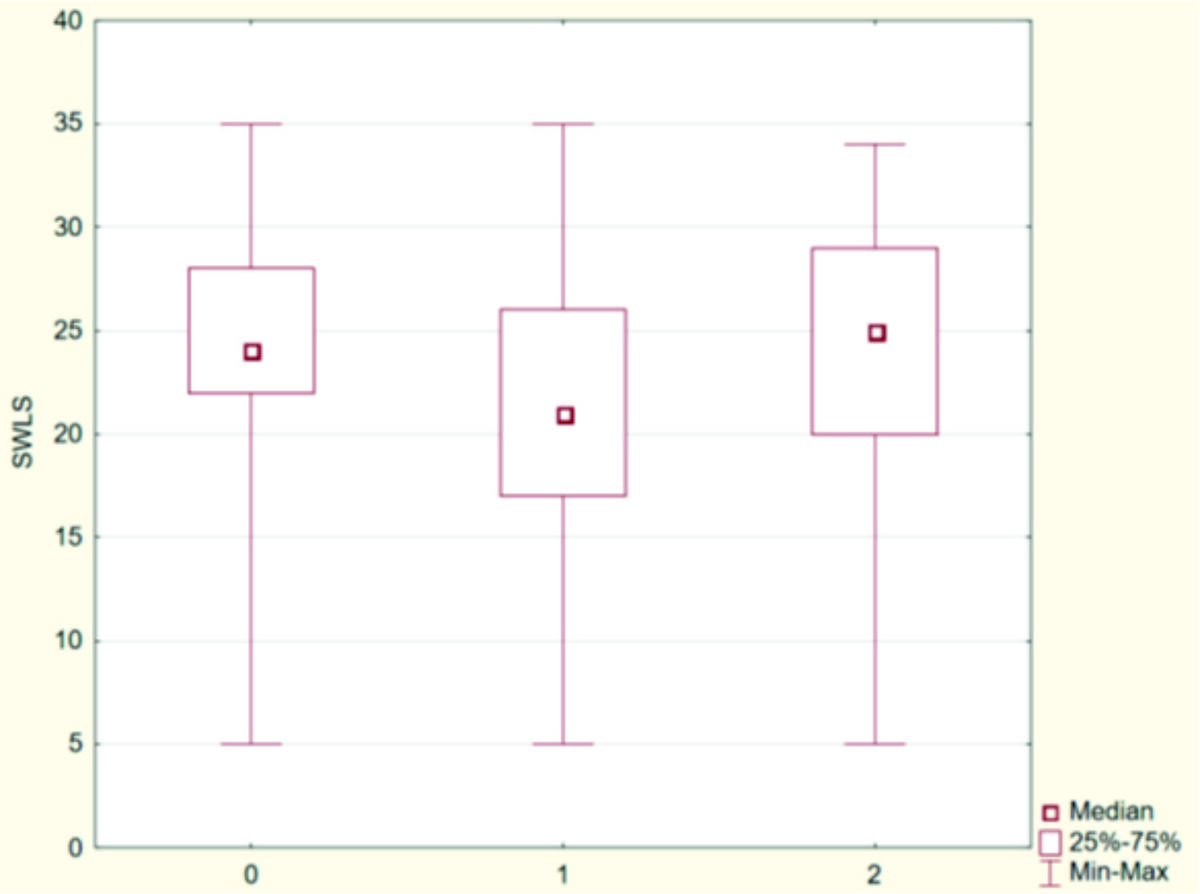
Wyniki uzyskane w kwestionariuszu SWLS wykazały istotną różnicę w zakresie satysfakcji z życia pomiędzy grupami uprawiającymi różne dyscypliny sportowe. Osoby uprawiające BJJ uzyskały 24 ± 5,952 pkt, trenujące MMA 21 ± 6,727 pkt, uprawiające obie dyscypliny 25 ± 6,704 pkt. Uzyskane wyniki są znaczące statystycznie (p = 0,029). W podskali HADS-A kobiety osiągały znamiennie statystycznie wyższe wyniki niż mężczyźni (p = 0,000). Ponadto wiek badanych oraz czas trenowania w latach wykazały istotne statystycznie dodatnie korelacje z wynikami uzyskanymi w skali HADS-A.
Wnioski:
Osoby trenujące wyłącznie MMA oceniły swoją satysfakcję z życia niżej niż osoby trenujące obie dyscypliny lub wyłącznie BJJ. Dłuższy okres uprawiania dyscypliny i starszy wiek ankietowanych były związane z mniejszym nasileniem objawów lękowych. Kobiety uzyskały wyższe wyniki w skali lęku niż mężczyźni.
Brazylijskie jiu-jitsu (BJJ) oraz mieszane sztuki walki (mixed martial arts – MMA) mogą zapewnić odpowiednią ilość ruchu, zapobiegając zaburzeniom psychicznym. Celem pracy było porównanie osób trenujących BJJ, MMA lub obie te dyscypliny pod względem występowania objawów depresji, lęku oraz poziomu satysfakcji z życia.
Materiał i metody:
W badaniu wzięło udział 229 osób (147 mężczyzn – 64,2%, i 82 kobiety – 35,8%) w wieku od 14 do 47 lat; średnia wieku wynosiła 29 ± 7,897 roku. BJJ trenowało 62,4% ankietowanych, MMA 16,2%, oba sporty 21,4%. Do oceny parametrów badanych użyto Skali satysfakcji z życia (Satisfaction With Life Scale – SWLS), Szpitalnej skali lęku i depresji (Hospital Anxiety and Depression Scale – HADS) oraz danych socjodemograficznych.
Wyniki:
Wyniki uzyskane w kwestionariuszu SWLS wykazały istotną różnicę w zakresie satysfakcji z życia pomiędzy grupami uprawiającymi różne dyscypliny sportowe. Osoby uprawiające BJJ uzyskały 24 ± 5,952 pkt, trenujące MMA 21 ± 6,727 pkt, uprawiające obie dyscypliny 25 ± 6,704 pkt. Uzyskane wyniki są znaczące statystycznie (p = 0,029). W podskali HADS-A kobiety osiągały znamiennie statystycznie wyższe wyniki niż mężczyźni (p = 0,000). Ponadto wiek badanych oraz czas trenowania w latach wykazały istotne statystycznie dodatnie korelacje z wynikami uzyskanymi w skali HADS-A.
Wnioski:
Osoby trenujące wyłącznie MMA oceniły swoją satysfakcję z życia niżej niż osoby trenujące obie dyscypliny lub wyłącznie BJJ. Dłuższy okres uprawiania dyscypliny i starszy wiek ankietowanych były związane z mniejszym nasileniem objawów lękowych. Kobiety uzyskały wyższe wyniki w skali lęku niż mężczyźni.
REFERENCJE (34)
1.
Reusing HM. The language of martial arts: The transformative potential of Brazilian jiu-jitsu through the lens of depth psychology. ProQuest LLC. Ann Arbor, MI, 2014.
2.
Spencer DC. Habit(us), body techniques and body callusing: An ethnography of mixed martial arts. Body Soc. 2009;15(4):119–143. doi: 10.1177/1357034X09347224.
4.
GBD 2019 Mental Disorders Collaborators. Global, regional, and national burden of 12 mental disorders in 204 countries and territories, 1990-2019: a systematic analysis for the Global Burden of Disease Study 2019. Lancet Psychiatry. 2022;9(2):137–150. doi: 10.1016/S2215-0366(21)00395-3.
5.
Wytyczne WHO dotyczące aktywności fizycznej i siedzącego trybu życia: omówienie [pdf]. Kopenhaga: Biuro Regionalne WHO na Europę; 2021. Licencja: CC BY-NC-SA 3.0 IGO; https://iris.who.int/bitstream....
6.
Imboden C, Claussen MC, Seifritz E, Gerber M. The Importance of Physical Activity for Mental Health. [Article in German]. Praxis (Bern 1994). 2022;110(4):186–191. doi: 10.1024/1661-8157/a003831.
7.
Lubecka B, Lubecki M, Kasperczyk J, Jośko-Ochojska J, Pudlo R. Risk Modifying Factors of Anxiety and Depressive Disorders, Using the Example of a Population Study in the Żywiec District. Int J Environ Res Public Health. 2021;18(19):10248. doi: 10.3390/ijerph181910248.
8.
An HY, Chen W, Wang CW, Yang HF, Huang WT, Fan SY. The Relationships between Physical Activity and Life Satisfaction and Happiness among Young, Middle-Aged, and Older Adults. Int J Environ Res Public Health. 2020;17(13):4817. doi: 10.3390/ijerph17134817.
9.
Maher JP, Pincus AL, Ram N, Conroy DE. Daily physical activity and life satisfaction across adulthood. Dev Psychol. 2015;51(10):1407–1419. doi: 10.1037/dev0000037.
10.
Cooney GM, Dwan K, Greig CA, Lawlor DA, Rimer J, Waugh FR, et al. Exercise for depression. Cochrane Database Syst Rev. 2013;2013(9):CD004366. doi: 10.1002/14651858.CD004366.pub6.
11.
Singh B, Olds T, Curtis R, Dumuid D, Virgara R, Watson A, et al. Effectiveness of physical activity interventions for improving depression, anxiety and distress: an overview of systematic reviews. Br J Sports Med. 2023;57(18):1203–1209. doi: 10.1136/bjsports-2022-106195.
12.
Saeed SA, Antonacci DJ, Bloch RM. Exercise, yoga, and meditation for depressive and anxiety disorders. Am Fam Physician. 2010;81(8):981–986.
13.
Willing AE, Girling SA, Deichert R, Wood-Deichert R, Gonzalez J, Hernandez D, et al. Brazilian Jiu Jitsu Training for US Service Members and Veterans with Symptoms of PTSD. Mil Med. 2019;184(11–12):e626–e631. doi: 10.1093/milmed/usz074.
14.
Blomqvist Mickelsson T. Modern unexplored martial arts – what can mixed martial arts and Brazilian Jiu-Jitsu do for youth development? Eur J Sport Sci. 2020;20(3):386–393. doi: 10.1080/17461391.2019.1629180.
15.
Diener E, Emmons RA, Larson RJ, Griffin S. Skala satysfakcji z życia – SWLS. In: Z. Juczyński [adapt.]. Narzędzia pomiaru w promocji i psychologii zdrowia. Pracownia Testów Psychologicznych Polskiego Towarzystwa Psychologicznego. Warszawa 2001, p. 134–138.
16.
Karakuła H, Grzywa A, Śpila B, Baszak J, Gieroba A, Kosikowski W, et al. Zastosowanie Skali Lęku i Depresji – HADS w chorobach psychosomatycznych. Psychiatr Pol. 1996;30(4):653–668.
17.
Bandelow B, Michaelis S. Epidemiology of anxiety disorders in the 21st century. Dialogues Clin Neurosci. 2015;17(3):327–335. doi: 10.31887/DCNS.2015.17.3/bbandelow.
18.
Layton C. Anxiety in black-belt and nonblack-belt traditional karateka. Percept Mot Skills. 1990;71(3 Pt 1):905–906. doi: 10.2466/PMS.71.7.905-906.
19.
Fernández MM, Brito CJ, Miarka B, Díaz-de-Durana AL. Anxiety and Emotional Intelligence: Comparisons Between Combat Sports, Gender and Levels Using the Trait Meta-Mood Scale and the Inventory of Situations and Anxiety Response. Front Psychol. 2020;11:130. doi: 10.3389/fpsyg.2020.00130. Erratum in: Front Psychol. 2020;11:889. doi: 10.3389/fpsyg.2020.00889.
20.
Smith T. Competition trait anxiety in youth sport: differences according to age, sex, race and playing status. Percept Mot Skills. 1983;57(3 Pt 2):1235–1238. doi: 10.2466/pms.1983.57.3f.1235.
21.
Imboden C, Gerber M, Beck J, Holsboer-Trachsler E, Pühse U, Hatzinger M. Aerobic exercise or stretching as add-on to inpatient treatment of depression: Similar antidepressant effects on depressive symptoms and larger effects on working memory for aerobic exercise alone. J Affect Disord. 2020;276:866–876. doi: 10.1016/j.jad.2020.07.052.
22.
Kvam S, Kleppe CL, Nordhus IH, Hovland A. Exercise as a treatment for depression: A meta-analysis. J Affect Disord. 2016;202:67–86. doi: 10.1016/j.jad.2016.03.063.
23.
Chekroud SR, Gueorguieva R, Zheutlin AB, Paulus M, Krumholz HM, Krystal JH, et al. Association between physical exercise and mental health in 1·2 million individuals in the USA between 2011 and 2015: a cross-sectional study. Lancet Psychiatry. 2018;5(9):739–746. doi: 10.1016/S2215-0366(18)30227-X.
24.
Wypych-Ślusarska A, Majer N, Krupa-Kotara K, Niewiadomska E. Active and Happy? Physical Activity and Life Satisfaction among Young Educated Women. Int J Environ Res Public Health. 2023;20(4):3145. doi: 10.3390/ijerph20043145.
25.
Eime R, Harvey J, Payne W. Dose-response of women’s health-related quality of life (HRQoL) and life satisfaction to physical activity. J Phys Act Health. 2014;11(2):330–338. doi: 10.1123/jpah.2012-0073.
26.
Potoczny W, Herzog-Krzywoszanska R, Krzywoszanski L. Self-Control and Emotion Regulation Mediate the Impact of Karate Training on Satisfaction With Life. Front Behav Neurosci. 2022;15:802564. doi: 10.3389/fnbeh.2021.802564.
27.
Kotarska K, Nowak L, Szark-Eckardt M, Nowak M. Selected Healthy Behaviors and Quality of Life in People Who Practice Combat Sports and Martial Arts. Int J Environ Res Public Health. 2019;16(5):875. doi: 10.3390/ijerph16050875.
28.
Hunzinger KJ, Caccese JB, Mannix R, Meehan WP 3rd, Swanik CB, Buckley TA. Contact or Collision Sport History, Repetitive Neurotrauma, and Patient-Reported Outcomes in Early to Midadulthood. J Athl Train. 2023;58(11–12):952–961. doi: 10.4085/1062-6050-0017.23.
29.
Vaquero Solís M, Sánchez-Miguel PA, Tapia Serrano MÁ, Pulido JJ, Iglesias Gallego D. Physical Activity as a Regulatory Variable between Adolescents’ Motivational Processes and Satisfaction with Life. Int J Environ Res Public Health. 2019;16(15):2765. doi: 10.3390/ijerph16152765.
30.
Villafaina S, Tapia-Serrano MÁ, Vaquero-Solís M, León-Llamas JL, Sánchez-Miguel PA. The Role of Physical Activity in the Relationship between Satisfaction with Life and Health-Related Quality of Life in School-Age Adolescents. Behav Sci (Basel). 2021;11(9):121. doi: 10.3390/bs11090121.
31.
McMahon EM, Corcoran P, O’Regan G, Keeley H, Cannon M, Carli V, et al. Physical activity in European adolescents and associations with anxiety, depression and well-being. Eur Child Adolesc Psychiatry. 2017;26(1):111–122. doi: 10.1007/s00787-016-0875-9.
32.
Dunn AL, Trivedi MH, Kampert JB, Clark CG, Chambliss HO. Exercise treatment for depression: Efficacy and dose response. Am J Prev Med. 2005;28(1):1–8. doi: 10.1016/j.amepre.2004.09.003.
33.
Rassovsky Y, Harwood A, Zagoory-Sharon O, Feldman R. Martial arts increase oxytocin production. Sci Rep. 2019;9(1):12980. doi: 10.1038/s41598-019-49620-0.
34.
Pluhar E, McCracken C, Griffith KL, Christino MA, Sugimoto D, Meehan WP 3rd. Team Sport Athletes May Be Less Likely To Suffer Anxiety or Depression than Individual Sport Athletes. J Sports Sci Med. 2019;18(3):490–496.
Udostępnij
ARTYKUŁ POWIĄZANY
| eISSN: | 1734-025X |


Śląski Uniwersytet Medyczny w Katowicach, jako Operator Serwisu annales.sum.edu.pl, przetwarza dane osobowe zbierane podczas odwiedzania Serwisu. Realizacja funkcji pozyskiwania informacji o Użytkownikach i ich zachowaniu odbywa się poprzez dobrowolnie wprowadzone w formularzach informacje, zapisywanie w urządzeniach końcowych plików cookies (tzw. ciasteczka), a także poprzez gromadzenie logów serwera www, będącego w posiadaniu Operatora Serwisu. Dane, w tym pliki cookies, wykorzystywane są w celu realizacji usług zgodnie z Polityką prywatności.
Możesz wyrazić zgodę na przetwarzanie danych w tych celach, odmówić zgody lub uzyskać dostęp do bardziej szczegółowych informacji.
Możesz wyrazić zgodę na przetwarzanie danych w tych celach, odmówić zgody lub uzyskać dostęp do bardziej szczegółowych informacji.