Bieżący numer
Artykuły zaakceptowane
O czasopiśmie
Rada Naukowa
Kolegium Redakcyjne
Polityka prawno-archiwizacyjna
Kodeks etyki publikacyjnej
Wydawca
Informacja o przetwarzaniu danych osobowych w ramach plików cookies oraz subskrypcji newslettera
Archiwum
Dla autorów
Dla recenzentów
Kontakt
Recenzenci
Recenzenci rocznika 2025
Recenzenci rocznika 2024
Recenzenci rocznika 2023
Recenzenci rocznika 2022
Recenzenci rocznika 2021
Recenzenci rocznika 2020
Recenzenci rocznika 2019
Recenzenci rocznika 2018
Recenzenci rocznika 2017
Recenzenci rocznika 2016
Recenzenci rocznika 2015
Recenzenci rocznika 2014
Recenzenci rocznika 2013
Recenzenci rocznika 2012
Polecamy
Śląski Uniwersytet Medyczny w Katowicach
Sklep Wydawnictw SUM
Biblioteka Główna SUM
Polityka prywatności
Deklaracja dostępności
Recenzenci
Recenzenci rocznika 2025
Recenzenci rocznika 2024
Recenzenci rocznika 2023
Recenzenci rocznika 2022
Recenzenci rocznika 2021
Recenzenci rocznika 2020
Recenzenci rocznika 2019
Recenzenci rocznika 2018
Recenzenci rocznika 2017
Recenzenci rocznika 2016
Recenzenci rocznika 2015
Recenzenci rocznika 2014
Recenzenci rocznika 2013
Recenzenci rocznika 2012

Myocarditis with multiorgan failure – 135 days fighting for life
1
Students’ Scientific Club, Department of Cardiac Anaesthesiology and Intensive Care, Faculty of Medical Sciences in Zabrze, Medical University of Silesia, Katowice, Poland
2
Department of Cardiac Anaesthesiology and Intensive Care, Faculty of Medical Sciences in Zabrze, Medical University of Silesia, Katowice, Poland
Autor do korespondencji
Emilia Słabońska
Studenckie Koło Naukowe, Klinika Kardioanestezji i Intensywnej Terapii, ul. M. Curie-Skłodowskiej 9, 41-800 Zabrze, Śląskie Centrum Chorób Serca, tel. +48 32 273 27 31
Studenckie Koło Naukowe, Klinika Kardioanestezji i Intensywnej Terapii, ul. M. Curie-Skłodowskiej 9, 41-800 Zabrze, Śląskie Centrum Chorób Serca, tel. +48 32 273 27 31

SŁOWA KLUCZOWE
TRALIliver abscessVA-ECMOmultidrug-resistant organismsmassive transfusionfulminant myocarditisvancomycin-resistant Enterococcus faecium
DZIEDZINY
STRESZCZENIE
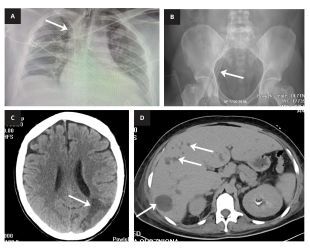
Fulminant myocarditis is a rare, life-threatening condition that rapidly progresses to refractory cardiogenic shock requiring mechanical circulatory support. Prolonged extracorporeal life support increases survival but exposes patients to severe hemorrhagic, thromboembolic, and infectious complications. We present a complex case of fulminant myocarditis complicated by prolonged VA-ECMO support, massive transfusions, multidrug-resistant infections, and hepatic abscess formation. A 29-year-old man was admitted with fulminant myocarditis, severe biventricular failure (left ventricular ejection fraction 10%), atrial fibrillation, and combined cardiogenic and septic shock. He required mechanical ventilation, veno-arterial extracorporeal membrane oxygenation (VA-ECMO), intra-aortic balloon pump (IABP), vasoactive support, and renal replacement therapy. Persistent bleeding from the ECMO site resulted in transfusion of 100 units of packed red blood cells over 110 days, complicated by mild transfusion-related acute lung injury. An occipital ischemic stroke without neurological deficits was diagnosed during hospitalization. Following successful VA-ECMO and IABP removal, the patient developed septic shock secondary to a groin wound infection caused by New Delhi metallo-β-lactamase-producing Klebsiella pneumoniae and Pseudomonas aeruginosa. Subsequently, multiple hepatic lesions suspicious for liver abscesses were identified. Percutaneous drainage yielded vancomycin-resistant Enterococcus faecium, prompting targeted antimicrobial therapy and transfer to a specialized hepatology center. Long-term veno-arterial extracorporeal membrane oxygenation serves as an effective bridge to recovery in patients with reversible profound circulatory failure. However, prolonged VA-ECMO support necessitates vigilant surveillance for hemorrhagic, thromboembolic, and infectious complications. A multidisciplinary management strategy is essential for optimizing clinical outcomes and patient prognosis.
REFERENCJE (4)
1.
Lango R, Szkulmowski Z, Maciejewski D, Sosnowski A, Kusza K. Revised protocol of extracorporeal membrane oxygenation (ECMO) therapy in severe ARDS. Recommendations of the Veno-venous ECMO Expert Panel appointed in February 2016 by the national consultant on anesthesiology and intensive care. Anaesthesiol Intensive Ther. 2017;49(2):88–99. doi: 10.5603/AIT.a2017.0028.
2.
Hughes T, Zhang D, Nair P, Buscher H. A systematic literature review of packed red cell transfusion usage in adult extracorporeal membrane oxygenation. Membranes (Basel). 2021;11(4):251. doi: 10.3390/membranes11040251.
3.
Moore EA, Han P, Shekar K, Ramanathan K, Riera del Brio J, Puslecki M, et al. ELSO 2025 Narrative Guideline on ECMO Training and Continuing Education. ASAIO J. 2026;72(4):274–283. doi: 10.1097/MAT.0000000000002686.
4.
Berger R, Nemeth A, Sandoval Boburg R, Vöhringer L, Lausberg HF, Acharya M, et al. Long-Term Follow-Up of Survivors of Extracorporeal Life Support Therapy for Cardiogenic Shock: Are They Really Survivors? Medicina. 2022;58(3):427. doi: 10.3390/medicina58030427.
Udostępnij
| eISSN: | 1734-025X |


Śląski Uniwersytet Medyczny w Katowicach, jako Operator Serwisu annales.sum.edu.pl, przetwarza dane osobowe zbierane podczas odwiedzania Serwisu. Realizacja funkcji pozyskiwania informacji o Użytkownikach i ich zachowaniu odbywa się poprzez dobrowolnie wprowadzone w formularzach informacje, zapisywanie w urządzeniach końcowych plików cookies (tzw. ciasteczka), a także poprzez gromadzenie logów serwera www, będącego w posiadaniu Operatora Serwisu. Dane, w tym pliki cookies, wykorzystywane są w celu realizacji usług zgodnie z Polityką prywatności.
Możesz wyrazić zgodę na przetwarzanie danych w tych celach, odmówić zgody lub uzyskać dostęp do bardziej szczegółowych informacji.
Możesz wyrazić zgodę na przetwarzanie danych w tych celach, odmówić zgody lub uzyskać dostęp do bardziej szczegółowych informacji.