Bieżący numer
Artykuły zaakceptowane
O czasopiśmie
Rada Naukowa
Kolegium Redakcyjne
Polityka prawno-archiwizacyjna
Kodeks etyki publikacyjnej
Wydawca
Informacja o przetwarzaniu danych osobowych w ramach plików cookies oraz subskrypcji newslettera
Archiwum
Dla autorów
Dla recenzentów
Kontakt
Recenzenci
Recenzenci rocznika 2025
Recenzenci rocznika 2024
Recenzenci rocznika 2023
Recenzenci rocznika 2022
Recenzenci rocznika 2021
Recenzenci rocznika 2020
Recenzenci rocznika 2019
Recenzenci rocznika 2018
Recenzenci rocznika 2017
Recenzenci rocznika 2016
Recenzenci rocznika 2015
Recenzenci rocznika 2014
Recenzenci rocznika 2013
Recenzenci rocznika 2012
Polecamy
Śląski Uniwersytet Medyczny w Katowicach
Sklep Wydawnictw SUM
Biblioteka Główna SUM
Polityka prywatności
Deklaracja dostępności
Recenzenci
Recenzenci rocznika 2025
Recenzenci rocznika 2024
Recenzenci rocznika 2023
Recenzenci rocznika 2022
Recenzenci rocznika 2021
Recenzenci rocznika 2020
Recenzenci rocznika 2019
Recenzenci rocznika 2018
Recenzenci rocznika 2017
Recenzenci rocznika 2016
Recenzenci rocznika 2015
Recenzenci rocznika 2014
Recenzenci rocznika 2013
Recenzenci rocznika 2012

Nurse-led oral care implementation for prevention of non-ventilator hospital-acquired pneumonia in hospitalized adults: A systematic review
1
Wydział Nauk o Zdrowiu, Wyższa Szkoła Gospodarki, Bydgoszcz / Faculty of Health Sciences, WSG University, Bydgoszcz, Poland
Autor do korespondencji
Paulina Kasperska-Dębowska
Wydział Nauk o Zdrowiu, Wyższa Szkoła Gospodarki, ul. Garbary 2, 85-229 Bydgoszcz, tel. +48 503 141 763
Wydział Nauk o Zdrowiu, Wyższa Szkoła Gospodarki, ul. Garbary 2, 85-229 Bydgoszcz, tel. +48 503 141 763

SŁOWA KLUCZOWE
DZIEDZINY
STRESZCZENIE
Introduction:
Non-ventilator hospital-acquired pneumonia (NV-HAP) is an important patient-safety problem in acute care. Oral care is increasingly recognized as a preventive nursing intervention, but implementation in routine practice remains insufficiently understood.
Methods:
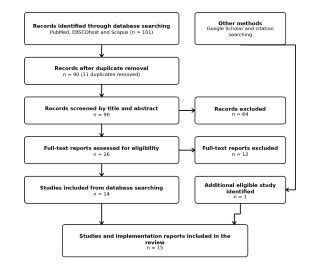
A systematic review with narrative synthesis was conducted in PubMed, EBSCOhost, and Scopus, supplemented by Google Scholar, citation tracking, and manual reference screening. Eligible studies involved hospitalized adults, nurse-led or nursing assistant-delivered oral care, and outcomes related to hospital-acquired pneumonia or NV-HAP. Study selection followed PRISMA 2020. Methodological quality was assessed using design-appropriate Joanna Briggs Institute (JBI) criteria.
Results:
Fifteen studies and implementation reports were included. Four recurring strategies were identified: staff education, protocolized oral care, documentation and monitoring systems, and multicomponent prevention bundles. These approaches generally improved staff knowledge, adherence, oral care frequency, and documentation. Clinical outcomes were less consistent, although several controlled and quasi-experimental studies reported reductions in NV-HAP. Most studies had moderate-to-high risk-of-bias concerns because of nonrandomized designs, uncontrolled before-after methods, and the inclusion of oral care within broader prevention programs.
Conclusions:
Nurse-led oral care is more likely to succeed when supported by education, standardized protocols, adequate supplies, documentation, leadership, and monitoring. However, the evidence remains heterogeneous and methodologically limited, so conclusions should be interpreted cautiously and generalized only to comparable acute care settings.
Non-ventilator hospital-acquired pneumonia (NV-HAP) is an important patient-safety problem in acute care. Oral care is increasingly recognized as a preventive nursing intervention, but implementation in routine practice remains insufficiently understood.
Methods:
A systematic review with narrative synthesis was conducted in PubMed, EBSCOhost, and Scopus, supplemented by Google Scholar, citation tracking, and manual reference screening. Eligible studies involved hospitalized adults, nurse-led or nursing assistant-delivered oral care, and outcomes related to hospital-acquired pneumonia or NV-HAP. Study selection followed PRISMA 2020. Methodological quality was assessed using design-appropriate Joanna Briggs Institute (JBI) criteria.
Results:
Fifteen studies and implementation reports were included. Four recurring strategies were identified: staff education, protocolized oral care, documentation and monitoring systems, and multicomponent prevention bundles. These approaches generally improved staff knowledge, adherence, oral care frequency, and documentation. Clinical outcomes were less consistent, although several controlled and quasi-experimental studies reported reductions in NV-HAP. Most studies had moderate-to-high risk-of-bias concerns because of nonrandomized designs, uncontrolled before-after methods, and the inclusion of oral care within broader prevention programs.
Conclusions:
Nurse-led oral care is more likely to succeed when supported by education, standardized protocols, adequate supplies, documentation, leadership, and monitoring. However, the evidence remains heterogeneous and methodologically limited, so conclusions should be interpreted cautiously and generalized only to comparable acute care settings.
FINANSOWANIE
Badania nie były finansowane ze środków zewnętrznych.
KONFLIKT INTERESÓW
Autor deklaruje brak konfliktu interesów.
REFERENCJE (20)
1.
Ehrenzeller S, Klompas M. Association between daily toothbrushing and hospital-acquired pneumonia: a systematic review and meta-analysis. JAMA Intern Med. 2024;184(2):131–142. doi: 10.1001/jamainternmed.2023.6638.
2.
Kaneoka A, Pisegna JM, Miloro KV, Lo M, Saito H, Riquelme LF, et al. Prevention of healthcare-associated pneumonia with oral care in individuals without mechanical ventilation: a systematic review and meta-analysis of randomized controlled trials. Infect Control Hosp Epidemiol. 2015;36(8):899–906. doi: 10.1017/ice.2015.77.
3.
Coker E, Ploeg J, Kaasalainen S, Carter N. Nurses’ oral hygiene care practices with hospitalized older adults in postacute settings. Int J Older People Nurs. 2017;12(1):e12124, doi: 10.1111/opn.12124.
4.
Kluberg SA, Chen T, Wang R, Jin R, DelloStritto L, Baker D, et al. Associations between routine oral care and in-hospital mobility with non-ventilator hospital-acquired pneumonia. Infect Control Hosp Epidemiol. 2025;46(12):1181–1189. doi: 10.1017/ice.2025.10245.
5.
Kozub E, Gorzycki E, Sidebottom A, Castro-Pearson S, Bryant R. Implementation of a structured oral hygiene program through nursing assistant education to address non-ventilator hospital-acquired pneumonia: A quasi-experimental study. J Nurs Scholarsh. 2025;57(2):204–215. doi: 10.1111/jnu.13018.
6.
Lacerna CC, Patey D, Block L, Naik S, Kevorkova Y, Galin J, et al. A successful program preventing nonventilator hospital-acquired pneumonia in a large hospital system. Infect Control Hosp Epidemiol. 2020;41(5):547–552. doi: 10.1017/ice.2019.368.
7.
McNally E, Krisciunas GP, Langmore SE, Crimlisk JT, Pisegna JM, Massaro J. Oral care clinical trial to reduce non-intensive care unit, hospital-acquired pneumonia: lessons for future research. J Healthc Qual. 2019;41(1):1–9. doi: 10.1097/JHQ.0000000000000131.
8.
Munro S, Phillips T, Hasselbeck R, Lucatorto MA, Hehr A, Ochylski S. Implementing oral care as a nursing intervention to reduce hospital-acquired pneumonia across the United States Department of Veterans Affairs Healthcare System. Comput Inform Nurs. 2022;40(1):35–43. doi: 10.1097/CIN.0000000000000808.
9.
Wilkinson A, Singal A, Ramadan G. Simple steps to prevent hospital-acquired pneumonia in non-intubated patients: a quality improvement project. Br J Nurs. 2021;30(2):110–115. doi: 10.12968/bjon.2021.30.2.110.
10.
Page MJ, McKenzie JE, Bossuyt PM, Boutron I, Hoffmann TC, Mulrow CD, et al. The PRISMA 2020 statement: an updated guideline for reporting systematic reviews. BMJ. 2021;372:n71. doi: 10.1136/bmj.n71.
11.
Barker TH, Stone JC, Sears K, Klugar M, Leonardi-Bee J, Tufanaru C, et al. Revising the JBI quantitative critical appraisal tools to improve their applicability: an overview of methods and the development process. JBI Evid Synth. 2023;21(3):478–493. doi: 10.11124/JBIES-22-00125.
12.
White NM, Russo PL, Matterson G, Browne K, Cheng AC, Kiernan M, et al. Effectiveness of oral care for the prevention of non-ventilator hospital-acquired pneumonia (HAPPEN): a multicentre, stepped-wedge, cluster-randomised trial in Australia. Lancet Infect Dis. 2026;S1473-3099(26)00235-5. doi: 10.1016/S1473-3099(26)00235-5.
13.
Robertson T, Carter D. Oral intensity: reducing non-ventilator-associated hospital-acquired pneumonia in care-dependent, neurologically impaired patients. Can J Neurosci Nurs. 2013;35(2):10–17.
14.
Quinn B, Baker DL, Cohen S, Stewart JL, Lima CA, Parise C. Basic nursing care to prevent nonventilator hospital-acquired pneumonia. J Nurs Scholarsh. 2014;46(1):11–19. doi: 10.1111/jnu.12050.
15.
Munro S, Haile-Mariam A, Greenwell C, Demirci S, Farooqi O, Vasudeva S. Implementation and dissemination of a Department of Veterans Affairs oral care initiative to prevent hospital-acquired pneumonia among nonventilated patients. Nurs Adm Q. 2018;42(4):363–372. doi: 10.1097/NAQ.0000000000000308.
16.
Munro S, Baker D. Reducing missed oral care opportunities to prevent non-ventilator associated hospital acquired pneumonia at the Department of Veterans Affairs. Appl Nurs Res. 2018;44:48–53. doi: 10.1016/j.apnr.2018.09.004.
17.
Warren C, Medei MK, Wood B, Schutte D. A nurse-driven oral care protocol to reduce hospital-acquired pneumonia. Am J Nurs. 2019;119(2):44–51. doi: 10.1097/01.NAJ.0000553204.21342.01.
18.
Pritts K, Kerber C, Calderon S, Bigler P. Implementation of a standardized oral care protocol to decrease non-ventilator hospital-acquired pneumonia. MedSurg Nurs. 2020;29(6):387–390.
19.
Giuliano KK, Penoyer D, Middleton A, Baker D. Oral care as prevention for nonventilator hospital-acquired pneumonia: a four-unit cluster randomized study. Am J Nurs. 2021;121(6):24–33. doi: 10.1097/01.NAJ.0000753468.99321.93.
20.
Stevenson LD, Munro S, Klocko R, Sayre G. A mixed-methods evaluation of the national implementation of the Hospital-Acquired Pneumonia Prevention by Engaging Nurses (HAPPEN) initiative. Infect Control Hosp Epidemiol. 2023;44(3):384–391. doi: 10.1017/ice.2022.99.
Udostępnij
ARTYKUŁ POWIĄZANY
| eISSN: | 1734-025X |


Śląski Uniwersytet Medyczny w Katowicach, jako Operator Serwisu annales.sum.edu.pl, przetwarza dane osobowe zbierane podczas odwiedzania Serwisu. Realizacja funkcji pozyskiwania informacji o Użytkownikach i ich zachowaniu odbywa się poprzez dobrowolnie wprowadzone w formularzach informacje, zapisywanie w urządzeniach końcowych plików cookies (tzw. ciasteczka), a także poprzez gromadzenie logów serwera www, będącego w posiadaniu Operatora Serwisu. Dane, w tym pliki cookies, wykorzystywane są w celu realizacji usług zgodnie z Polityką prywatności.
Możesz wyrazić zgodę na przetwarzanie danych w tych celach, odmówić zgody lub uzyskać dostęp do bardziej szczegółowych informacji.
Możesz wyrazić zgodę na przetwarzanie danych w tych celach, odmówić zgody lub uzyskać dostęp do bardziej szczegółowych informacji.