Bieżący numer
Artykuły zaakceptowane
O czasopiśmie
Rada Naukowa
Kolegium Redakcyjne
Polityka prawno-archiwizacyjna
Kodeks etyki publikacyjnej
Wydawca
Informacja o przetwarzaniu danych osobowych w ramach plików cookies oraz subskrypcji newslettera
Archiwum
Dla autorów
Dla recenzentów
Kontakt
Recenzenci
Recenzenci rocznika 2025
Recenzenci rocznika 2024
Recenzenci rocznika 2023
Recenzenci rocznika 2022
Recenzenci rocznika 2021
Recenzenci rocznika 2020
Recenzenci rocznika 2019
Recenzenci rocznika 2018
Recenzenci rocznika 2017
Recenzenci rocznika 2016
Recenzenci rocznika 2015
Recenzenci rocznika 2014
Recenzenci rocznika 2013
Recenzenci rocznika 2012
Polecamy
Śląski Uniwersytet Medyczny w Katowicach
Sklep Wydawnictw SUM
Biblioteka Główna SUM
Polityka prywatności
Deklaracja dostępności
Recenzenci
Recenzenci rocznika 2025
Recenzenci rocznika 2024
Recenzenci rocznika 2023
Recenzenci rocznika 2022
Recenzenci rocznika 2021
Recenzenci rocznika 2020
Recenzenci rocznika 2019
Recenzenci rocznika 2018
Recenzenci rocznika 2017
Recenzenci rocznika 2016
Recenzenci rocznika 2015
Recenzenci rocznika 2014
Recenzenci rocznika 2013
Recenzenci rocznika 2012

Disease progression or treatment-related complication? When mogamulizumab misleads in the management of Sézary syndrome: A case report
1
Department of Bone Marrow Transplantation and Oncohematology, Maria Sklodowska-Curie National Research Institute of Oncology, Gliwice Branch, Poland
2
RADIO(T)RACERS Students’ Scientific Club, Department of Oncology, Faculty of Medical Sciences in Zabrze, Medical University of Silesia, Katowice, Poland
Autor do korespondencji
Anastazja Szlauer-Stefańska
Klinika Transplantacji Szpiku i Onkohematologii, Narodowy Instytut Onkologii im. Marii Skłodowskiej-Curie, Państwowy Instytut Badawczy, Oddział w Gliwicach, ul. Wybrzeże Armii Krajowej 15, 44-102 Gliwice, tel. +48 32 278 85 60
Klinika Transplantacji Szpiku i Onkohematologii, Narodowy Instytut Onkologii im. Marii Skłodowskiej-Curie, Państwowy Instytut Badawczy, Oddział w Gliwicach, ul. Wybrzeże Armii Krajowej 15, 44-102 Gliwice, tel. +48 32 278 85 60

SŁOWA KLUCZOWE
mogamulizumabmogamulizumab-associated rashcutaneous T-cell lymphomaadverse drug reactionerythrodermarash
DZIEDZINY
STRESZCZENIE
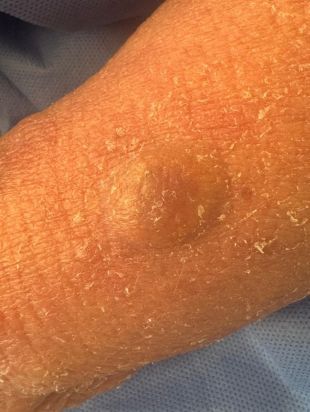
Sézary syndrome (SS) is a cutaneous T-cell lymphoma characterized by aggressiveness, rarity, and poor outcome. When the disease becomes advanced (from stage IIB), mogamulizumab (MOGA) is a treatment option with potential adverse effects, including mogamulizumab-associated rash (MAR). The similarity between the symptoms of MAR and SS progression can lead to a delay in starting the next line of potentially effective treatment. This case illustrates the difficulties in distinguishing MAR from SS progression during MOGA treatment. In February 2024, a patient received an SS diagnosis, showing symptoms like erythroderma and inguinal lymphadenopathy. The flow cytometry confirmed the blood involvement. MOGA treatment began in April 2025, after three unsuccessful lines of systemic treatment. After the first cycle, the patient developed severe scaling, widespread erythroderma, and fever, raising concerns about MAR. MOGA was temporarily discontinued, and systemic corticosteroid therapy was initiated. A skin biopsy showed non-specific findings. One month later, MOGA was reintroduced, but new skin lesions appeared. Repeated histopathological examination pointed toward SS progression rather than a drug-related complication. The subsequent clinical course was complicated by bacteremia and secondary skin infections. Next, bridging therapy with bexarotene was initiated, and the patient was referred for allogeneic hematopoietic stem cell transplantation. This case emphasizes the diagnostic and treatment difficulties associated with overlapping clinical and histopathologic features of SS and MAR. It also underscores the importance of an individual approach, repeated clinicopathologic evaluations, and multidisciplinary collaboration. Thus, it may help improve treatment outcomes and patient prognosis.
FINANSOWANIE
Badania nie były finansowane.
KONFLIKT INTERESÓW
Autorzy deklarują brak konfliktu interesów.
DODATKOWE INFORMACJE
Oświadczenie o świadomej zgodzie: Pacjent wyraził zgodę na publikację zdjęć oraz innych informacji klinicznych.
REFERENCJE (16)
1.
NCCN Guidelines for Patients® Cutaneous T-Cell Lymphomas. Fort Washington, PA: National Comprehensive Cancer Network, 2024.
2.
Sokołowska Wojdyło M, Olszewska B, Chmielowska E, Robak E, Prochorec-Sobieszek M, Kamińska-Winciorek G, et al. Primary cutaneous lymphomas. Diagnostic and therapeutic guidelines of the Polish Dermatological Society (PTD) and Polish Lymphoma Research Group (PLRG). Dermatol Rev./Przegl Dermatol. 2023;110(6):647–674. doi: 10.5114/dr.2023.138937.
3.
Sézary syndrome – Orphanet. Orphanet Encyclopaedia; 3162 [online] https://www.orpha.net/en/disea... (accessed Jan 2026).
4.
Campbell JJ, Clark RA, Watanabe R, Kupper TS. Sézary syndrome and mycosis fungoides arise from distinct T-cell subsets: a biologic rationale for their distinct clinical behaviors. Blood. 2010;116(5):767–771. doi: 10.1182/blood-2009-11-251926.
5.
NCCN Clinical Practice Guidelines in Oncology (NCCN Guidelines®) for Primary Cutaneous Lymphomas, Version 1.2025. Fort Washington, PA: National Comprehensive Cancer Network, 2025.
6.
Latzka J, Assaf C, Bagot M, Cozzio A, Dummer R, Guenova E, et al. EORTC consensus recommendations for the treatment of mycosis fungoides/Sézary syndrome – update 2023. Eur J Cancer. 2023;195:113343. doi: 10.1016/j.ejca.2023.113343.
7.
Kim YH, Bagot M, Pinter-Brown L, Rook AH, Porcu P, Horwitz SM, et al. Mogamulizumab versus vorinostat in previously treated cutaneous T-cell lymphoma (MAVORIC): an international, open-label, randomised, controlled phase 3 trial. Lancet Oncol. 2018;19(9):1192–1204. doi: 10.1016/S1470-2045(18)30379-6.
8.
Duvic M, Evans M, Wang C. Mogamulizumab for the treatment of cutaneous T-cell lymphoma: recent advances and clinical potential. Ther Adv Hematol. 2016;7(3):171–174. doi: 10.1177/2040620716636541.
9.
Musiek ACM, Rieger KE, Bagot M, Choi JN, Fisher DC, Guitart J, et al. Dermatologic events associated with the anti CCR4 antibody mogamulizumab: characterization and management. Dermatol Ther (Heidelb). 2022;12(1):29–40. doi: 10.1007/s13555 021 00624 7.
10.
Hirotsu KE, Neal TM, Khodadoust MS, Wang JY, Rieger KE, Strelo J, et al. Clinical Characterization of Mogamulizumab-Associated Rash During Treatment of Mycosis Fungoides or Sézary Syndrome. JAMA Dermatol. 2021;157(6):700–707. doi: 10.1001/jamadermatol.2021.0877.
11.
Larocca C, Kupper TS, LeBoeuf NR. Mogamulizumab Forecast: Clearer Patients, with a Slight Chance of Immune Mayhem. Clin Cancer Res. 2019;25(24):7272–7274. doi: 10.1158/1078-0432.CCR-19-2742.
12.
Dai J, Almazan TH, Hong EK, Khodadoust MS, Arai S, Weng WK, et al. Potential association of anti CCR4 antibody mogamulizumab and graft vs host disease in patients with mycosis fungoides and Sézary syndrome. JAMA Dermatol. 2018;154(6):728–730. doi: 10.1001/jamadermatol.2018.0884.
13.
Beylot Barry M, Quereux G, Nardin C, Duval-Modeste AB, Dereure O, Dalac-Rat S, et al. Effectiveness of mogamulizumab in patients with Mycosis Fungoides or Sézary syndrome: A multicentre, retrospective, real-world French study. J Eur Acad Dermatol Venereol. 2023;37(9):1777–1784. doi: 10.1111/jdv.19134.
14.
Pilkington J, Ly S, Kayishunge D, Gentille C, Wong HK. Mogamulizumab in combination improves clinical outcomes in relapsed and refractory Sézary syndrome. Front Hematol. 2025;4:1557641. doi: 10.3389/frhem.2025.1557641.
15.
Modak D, Guha SK. Severe skin rash with lamivudine in HIV infected patients: some unusual case reports. Indian J Pharmacol. 2013;45(3):298–300. doi: 10.4103/0253-7613.111906.
16.
Mitteldorf C. Novel and recurrent histopathologic patterns of mogamulizumab-associated rash: diagnostic implications and insights for accurate diagnosis. J Dtsch Dermatol Ges. 2025;23(8):942–956. doi: 10.1111/ddg.15773.
Udostępnij
| eISSN: | 1734-025X |


Śląski Uniwersytet Medyczny w Katowicach, jako Operator Serwisu annales.sum.edu.pl, przetwarza dane osobowe zbierane podczas odwiedzania Serwisu. Realizacja funkcji pozyskiwania informacji o Użytkownikach i ich zachowaniu odbywa się poprzez dobrowolnie wprowadzone w formularzach informacje, zapisywanie w urządzeniach końcowych plików cookies (tzw. ciasteczka), a także poprzez gromadzenie logów serwera www, będącego w posiadaniu Operatora Serwisu. Dane, w tym pliki cookies, wykorzystywane są w celu realizacji usług zgodnie z Polityką prywatności.
Możesz wyrazić zgodę na przetwarzanie danych w tych celach, odmówić zgody lub uzyskać dostęp do bardziej szczegółowych informacji.
Możesz wyrazić zgodę na przetwarzanie danych w tych celach, odmówić zgody lub uzyskać dostęp do bardziej szczegółowych informacji.