Bieżący numer
Artykuły zaakceptowane
O czasopiśmie
Rada Naukowa
Kolegium Redakcyjne
Polityka prawno-archiwizacyjna
Kodeks etyki publikacyjnej
Wydawca
Informacja o przetwarzaniu danych osobowych w ramach plików cookies oraz subskrypcji newslettera
Archiwum
Dla autorów
Dla recenzentów
Kontakt
Recenzenci
Recenzenci rocznika 2025
Recenzenci rocznika 2024
Recenzenci rocznika 2023
Recenzenci rocznika 2022
Recenzenci rocznika 2021
Recenzenci rocznika 2020
Recenzenci rocznika 2019
Recenzenci rocznika 2018
Recenzenci rocznika 2017
Recenzenci rocznika 2016
Recenzenci rocznika 2015
Recenzenci rocznika 2014
Recenzenci rocznika 2013
Recenzenci rocznika 2012
Polecamy
Śląski Uniwersytet Medyczny w Katowicach
Sklep Wydawnictw SUM
Biblioteka Główna SUM
Polityka prywatności
Deklaracja dostępności
Recenzenci
Recenzenci rocznika 2025
Recenzenci rocznika 2024
Recenzenci rocznika 2023
Recenzenci rocznika 2022
Recenzenci rocznika 2021
Recenzenci rocznika 2020
Recenzenci rocznika 2019
Recenzenci rocznika 2018
Recenzenci rocznika 2017
Recenzenci rocznika 2016
Recenzenci rocznika 2015
Recenzenci rocznika 2014
Recenzenci rocznika 2013
Recenzenci rocznika 2012

Metachronous spindle cell sarcoma of the lung with spinal cord infiltration in a patient following oncological treatment: A case report
1
Students’ Scientific Club at the Department of Internal Medicine, Metabolic Diseases and Angiology, Faculty of Health Sciences in Katowice, Medical University of Silesia, Katowice, Poland
2
Department of Internal Medicine, Metabolic Diseases and Angiology, Upper-Silesian Medical Centre of the Medical University of Silesia in Katowice, Poland
3
Department of Internal Medicine, Metabolic Diseases and Angiology, Faculty of Health Sciences in Katowice, Medical University of Silesia, Katowice, Poland
Autor do korespondencji
Tomasz Fajferek
Studenckie Koło Naukowe, Klinika Chorób Wewnętrznych, Metabolicznych i Angiologii, ul. Ziołowa 45, 40-635 Katowice
Studenckie Koło Naukowe, Klinika Chorób Wewnętrznych, Metabolicznych i Angiologii, ul. Ziołowa 45, 40-635 Katowice

SŁOWA KLUCZOWE
spindle cell sarcomamalignant spinal cord compressionprimary pulmonary sarcomametachronous malignancypalliative carefollicular lymphoma
DZIEDZINY
STRESZCZENIE
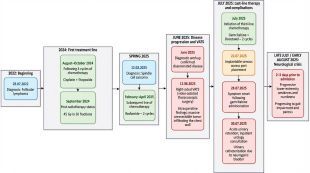
Primary pulmonary sarcomas are exceptionally rare, and pulmonary spindle cell sarcomas represent an even rarer, highly aggressive subset. Their clinical presentation is often nonspecific, and rapid local invasion may culminate in malignant spinal cord compression (MSCC), posing urgent diagnostic and therapeutic challenges. A 60-year-old man with a history of follicular lymphoma treated with O-CHOP and obinutuzumab maintenance subsequently developed a metachronous undifferentiated spindle cell sarcoma of the right upper lobe with pleural dissemination (FNCLCC grade 2). Despite multimodal therapy including cisplatin/etoposide and thoracic radiotherapy, followed by ifosfamide-imaging in June 2025 demonstrated rapid progression. Right-sided video-assisted thoracoscopic surgery revealed a massive, unresectable tumor infiltrating the chest wall. A subsequent gemcitabine/docetaxel regimen was initiated; shortly thereafter, the patient developed acute urinary retention and rapidly progressive lower-limb sensory symptoms evolving to paraparesis. Computed tomography showed a 127 × 99 × 165 mm right upper-lobe mass with osseous invasion and intraspinal extension at Th4–Th6 and Th11–Th12, with additional liver and bilateral renal metastases. Laboratory testing demonstrated severe anemia, thrombocytopenia, and markedly elevated inflammatory markers. Management included transfusion support, high-dose corticosteroids, antibiotics for MRSE urinary infection, and opioid-based analgesia. Given disseminated disease and ECOG 4 performance status, neurosurgical decompression and further systemic therapy were withheld, and the patient was discharged to home hospice. Abrupt neurological deterioration in aggressive thoracic sarcoma mandates urgent evaluation for MSCC; in terminal disseminated disease, early goal-concordant palliative care is essential.
REFERENCJE (39)
1.
Pleština S, Librenjak N, Marušić A, Batelja Vuletić L, Janevski Z, Jakopović M. An extremely rare primary sarcoma of the lung with peritoneal and small bowel metastases: a case report. World J Surg Oncol. 2019;17(1):147. doi: 10.1186/s12957-019-1691-8.
2.
Gołota J, Osowiecka K, Orłowski T. Primary pulmonary sarcoma – long-term treatment outcomes and prognostic factors. Kardiochir Torakochir Pol. 2018;15(3):162–169. doi: 10.5114/kitp.2018.78440.
3.
Gonçalves MJ, Mendes MM, João F, Lopes JM, Honavar M. Primary pleomorphic sarcoma of lung – 11 year survival. Rev Port Pneumol (Engl Ed). 2011;17(1):44–47. doi: 10.1016/S2173-5115(11)70010-0.
4.
Collini P, Sorensen PH, Patel S, Blay JY, Issels RD, Maki RG, et al. Sarcomas with spindle cell morphology. Semin Oncol. 2009;36(4):324–337. doi: 10.1053/j.seminoncol.2009.06.007.
5.
Allen AH, Gullixson AC. Spindle Cell Sarcoma of the Paraspinal Musculature with Late Pulmonary Metastases. Am J Case Rep. 2019;20:828–832. doi: 10.12659/AJCR.915602.
6.
Weissferdt A, Kalhor N, Rodriguez Canales J, Fujimoto J, Wistuba II, Moran CA. Spindle cell and pleomorphic (“sarcomatoid”) carcinomas of the lung: an immunohistochemical analysis of 86 cases. Hum Pathol. 2017;59:1–9. doi: 10.1016/j.humpath.2016.08.003.
7.
Levack P, Graham J, Collie D, Grant R, Kidd J, Kunkler I, et al. Don’t wait for a sensory level--listen to the symptoms: a prospective audit of the delays in diagnosis of malignant cord compression. Clin Oncol (R Coll Radiol). 2002;14(6):472–480. doi: 10.1053/clon.2002.0098.
8.
Savage P, Sharkey R, Kua T, Schofield L, Richardson D, Panchmatia N, et al. Malignant spinal cord compression: NICE guidance, improvements and challenges. QJM. 2014;107(4):277–282. doi: 10.1093/qjmed/hct244.
9.
Al-Qurainy R, Collis E. Metastatic spinal cord compression: diagnosis and management. BMJ. 2016;353:i2539. doi: 10.1136/bmj.i2539.
10.
Chantharakhit C, Sujaritvanichpong N. Prognostic Scoring System Development for Malignant Spinal Cord Compression. Asian Pac J Cancer Prev. 2022;23(2):623–630. doi: 10.31557/APJCP.2022.23.2.623.
11.
Qorbani A, Nelson SD. Primary pulmonary undifferentiated pleomorphic sarcoma (PPUPS). Autops Case Rep. 2019;9(3):e2019110. doi: 10.4322/acr.2019.110.
12.
Sbaraglia M, Bellan E, Dei Tos AP. The 2020 WHO Classification of Soft Tissue Tumours: news and perspectives. Pathologica. 2021;113(2):70–84. doi: 10.32074/1591-951X-213.
13.
Suster D. Spindle cell tumors of the mediastinum. Ann Diagn Pathol. 2022;60:152018. doi: 10.1016/j.anndiagpath.2022.152018.
14.
Schonfeld SJ, Merino DM, Curtis RE, Berrington de González A, Herr MM, Kleinerman RA, et al. Risk of Second Primary Bone and Soft-Tissue Sarcomas Among Young Adulthood Cancer Survivors. JNCI Cancer Spectr. 2019;3(3):pkz043. doi: 10.1093/jncics/pkz043.
15.
Sill H, Olipitz W, Zebisch A, Schulz E, Wölfler A. Therapy-related myeloid neoplasms: pathobiology and clinical characteristics. Br J Pharmacol. 2011;162(4):792–805. doi: 10.1111/j.1476-5381.2010.01100.x.
16.
Nakamura T, Matsumine A, Matsubara T, Asanuma K, Uchida A, Sudo A. Clinical characteristics of patients with large and deep soft tissue sarcomas. Oncol Lett. 2015;10(2):841–844. doi: 10.3892/ol.2015.3289.
17.
Allegra A, Tonacci A, Musolino C, Pioggia G, Gangemi S. Secondary Immunodeficiency in Hematological Malignancies: Focus on Multiple Myeloma and Chronic Lymphocytic Leukemia. Front Immunol. 2021;12:738915. doi: 10.3389/fimmu.2021.738915.
18.
Jolles S, Giralt S, Kerre T, Lazarus HM, Mustafa SS, Ria R, et al. Agents contributing to secondary immunodeficiency development in patients with multiple myeloma, chronic lymphocytic leukemia and non-Hodgkin lymphoma: A systematic literature review. Front Oncol. 2023;13:1098326. doi: 10.3389/fonc.2023.1098326.
19.
Thoenen E, Curl A, Iwakuma T. TP53 in bone and soft tissue sarcomas. Pharmacol Ther. 2019;202:149–164. doi: 10.1016/j.pharmthera.2019.06.010.
20.
Singer E, Elsayem A, Nassif T, Rodriguez C, Zoghbi M, Dagher J, et al. Initial management and disposition of metastatic spinal cord compression in the emergency department: a review of the literature. Ann Med. 2025;57(1):2568117. doi: 10.1080/07853890.2025.2568117.
21.
Lawton AJ, Lee KA, Cheville AL, Ferrone ML, Rades D, Balboni TA, et al. Assessment and Management of Patients With Metastatic Spinal Cord Compression: A Multidisciplinary Review. J Clin Oncol. 2019;37(1):61–71. doi: 10.1200/JCO.2018.78.1211.
22.
Lo WY, Yang SH. Metastatic spinal cord compression (MSCC) treated with palliative decompression: Surgical timing and survival rate. PLoS One. 2017;12(12):e0190342. doi: 10.1371/journal.pone.0190342.
23.
Rades D, Segedin B, Schild SE, Lomidze D, Veninga T, Cacicedo J. Identifying patients with malignant spinal cord compression (MSCC) near end of life who can benefit from palliative radiotherapy. Radiat Oncol. 2022;17(1):143. doi: 10.1186/s13014-022-02117-z.
24.
Magnuson FS, Christensen P, Krassioukov A, Rodriguez G, Emmanuel A, Kirshblum S, et al. Neurogenic Bowel Dysfunction in Patients with Spinal Cord Injury and Multiple Sclerosis — An Updated and Simplified Treatment Algorithm. J Clin Med. 2023;12(22):6971. doi: 10.3390/jcm12226971.
25.
Hakim S, Gaglani T, Cash BD. Neurogenic Bowel Dysfunction: The Impact of the Central Nervous System in Constipation and Fecal Incontinence. Gastroenterol Clin North Am. 2022;51(1):93–105. doi: 10.1016/j.gtc.2021.10.006.
26.
Blair HA. Naldemedine: A Review in Opioid-Induced Constipation. Drugs. 2019;79(11):1241–1247. doi: 10.1007/s40265-019-01160-7.
27.
Hamano J, Higashibata T, Kessoku T, Kajiura S, Hirakawa M, Oyamada S, et al. Naldemedine for Opioid-Induced Constipation in Patients With Cancer: A Multicenter, Double-Blind, Randomized, Placebo-Controlled Trial. J Clin Oncol. 2024;42(35):4206–4217. doi: 10.1200/JCO.24.00381.
28.
Cotterill N, Madersbacher H, Wyndaele JJ, Apostolidis A, Drake MJ, Gajewski J, et al. Neurogenic bowel dysfunction: Clinical management recommendations of the Neurologic Incontinence Committee of the Fifth International Consultation on Incontinence 2013. Neurourol Urodyn. 2018;37(1):46–53. doi: 10.1002/nau.23289.
29.
Emmanuel A. Neurogenic bowel dysfunction. F1000Research. 2019;8:F1000 Faculty Rev-1800. doi: 10.12688/f1000research.20529.1.
30.
Ye Y, Su X, Tang J, Zhu C. Neuropathic Pain Induced by Spinal Cord Injury from the Glia Perspective and Its Treatment. Cell Mol Neurobiol. 2024;44(1):81. doi: 10.1007/s10571-024-01517-x.
31.
Liu JJ, Brenner DM. Opioid-Related Constipation. Gastroenterol Clin North Am. 2022;51(1):107–121. doi: 10.1016/j.gtc.2021.10.007.
32.
Samuelson Bannow BT, Lee A, Khorana AA, Zwicker JI, Noble S, Ay C, et al. Management of cancer-associated thrombosis in patients with thrombocytopenia: guidance from the SSC of the ISTH. J Thromb Haemost. 2018;16(6):1246–1249. doi: 10.1111/jth.14015.
33.
Temel JS, Greer JA, Muzikansky A, Gallagher ER, Admane S, Jackson VA, et al. Early palliative care for patients with metastatic non-small-cell lung cancer. N Engl J Med. 2010;363(8):733–742. doi: 10.1056/NEJMoa1000678.
34.
Prigerson HG, Bao Y, Shah MA, Paulk ME, LeBlanc TW, Schneider BJ, et al. Chemotherapy Use, Performance Status, and Quality of Life at the End of Life. JAMA Oncol. 2015;1(6):778–784. doi: 10.1001/jamaoncol.2015.2378.
35.
Hui D, Kim SH, Roquemore J, Dev R, Chisholm G, Bruera E. Impact of timing and setting of palliative care referral on quality of end-of-life care in cancer patients. Cancer. 2014;120(11):1743–1749. doi: 10.1002/cncr.28628.
36.
Schnipper LE, Smith TJ, Raghavan D, Blayney DW, Ganz PA, Mulvey TM, et al. American Society of Clinical Oncology identifies five key opportunities to improve care and reduce costs: the top five list for oncology. J Clin Oncol. 2012;30(14):1715–1724. doi: 10.1200/JCO.2012.42.8375.
37.
Van Cutsem E, Nordlinger B, Cervantes A; ESMO Guidelines Working Group. Advanced colorectal cancer: ESMO Clinical Practice Guidelines for treatment. Ann Oncol. 2010;21 Suppl 5:v93–97. doi: 10.1093/annonc/mdq222.
38.
Schneiderman LJ, Jecker NS, Jonsen AR. Medical futility: its meaning and ethical implications. Ann Intern Med. 1990;112(12):949–954. doi: 10.7326/0003-4819-112-12-949.
39.
Bosslet GT, Pope TM, Rubenfeld GD, Lo B, Truog RD, Rushton CH, et al. An Official ATS/AACN/ACCP/ESICM/SCCM Policy Statement: Responding to Requests for Potentially Inappropriate Treatments in Intensive Care Units. Am J Respir Crit Care Med. 2015;191(11):1318–1330. doi: 10.1164/rccm.201505-0924ST.
| eISSN: | 1734-025X |


Śląski Uniwersytet Medyczny w Katowicach, jako Operator Serwisu annales.sum.edu.pl, przetwarza dane osobowe zbierane podczas odwiedzania Serwisu. Realizacja funkcji pozyskiwania informacji o Użytkownikach i ich zachowaniu odbywa się poprzez dobrowolnie wprowadzone w formularzach informacje, zapisywanie w urządzeniach końcowych plików cookies (tzw. ciasteczka), a także poprzez gromadzenie logów serwera www, będącego w posiadaniu Operatora Serwisu. Dane, w tym pliki cookies, wykorzystywane są w celu realizacji usług zgodnie z Polityką prywatności.
Możesz wyrazić zgodę na przetwarzanie danych w tych celach, odmówić zgody lub uzyskać dostęp do bardziej szczegółowych informacji.
Możesz wyrazić zgodę na przetwarzanie danych w tych celach, odmówić zgody lub uzyskać dostęp do bardziej szczegółowych informacji.