Bieżący numer
Artykuły zaakceptowane
O czasopiśmie
Rada Naukowa
Kolegium Redakcyjne
Polityka prawno-archiwizacyjna
Kodeks etyki publikacyjnej
Wydawca
Informacja o przetwarzaniu danych osobowych w ramach plików cookies oraz subskrypcji newslettera
Archiwum
Dla autorów
Dla recenzentów
Kontakt
Recenzenci
Recenzenci rocznika 2025
Recenzenci rocznika 2024
Recenzenci rocznika 2023
Recenzenci rocznika 2022
Recenzenci rocznika 2021
Recenzenci rocznika 2020
Recenzenci rocznika 2019
Recenzenci rocznika 2018
Recenzenci rocznika 2017
Recenzenci rocznika 2016
Recenzenci rocznika 2015
Recenzenci rocznika 2014
Recenzenci rocznika 2013
Recenzenci rocznika 2012
Polecamy
Śląski Uniwersytet Medyczny w Katowicach
Sklep Wydawnictw SUM
Biblioteka Główna SUM
Polityka prywatności
Deklaracja dostępności
Recenzenci
Recenzenci rocznika 2025
Recenzenci rocznika 2024
Recenzenci rocznika 2023
Recenzenci rocznika 2022
Recenzenci rocznika 2021
Recenzenci rocznika 2020
Recenzenci rocznika 2019
Recenzenci rocznika 2018
Recenzenci rocznika 2017
Recenzenci rocznika 2016
Recenzenci rocznika 2015
Recenzenci rocznika 2014
Recenzenci rocznika 2013
Recenzenci rocznika 2012

Przezotworowa lędźwiowa stabilizacja międzytrzonowa L4/L5 u 72-letniego świadka Jehowy z rakiem prostaty w wywiadzie – opis przypadku zgodny ze standardami zarządzania krwią pacjenta

1
Department of Medical Biophysics, Faculty of Medical Sciences in Katowice, Medical University of Silesia, Katowice, Poland
2
Gabriel Narutowicz Municipal Specialist Hospital, Cracow, Poland
Autor do korespondencji
Ann. Acad. Med. Siles. 2026;80:171-178

SŁOWA KLUCZOWE
stenoza kanału kręgowego odcinka lędźwiowegodiscektomiaprzezotworowa lędźwiowa stabilizacja międzytrzonowazarządzanie krwią pacjentachromanie neurogennechirurgia kręgosłupa
DZIEDZINY
STRESZCZENIE
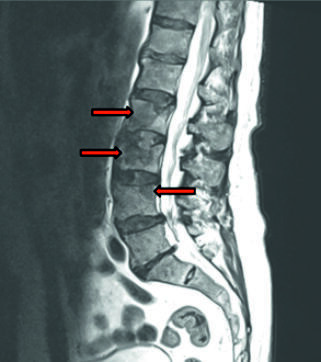
Stenoza kanału kręgowego odcinka lędźwiowego (lumbar spinal stenosis – LSS) jest częstym schorzeniem zwyrodnieniowym u osób starszych, prowadzącym do przewlekłego bólu dolnego odcinka pleców, chromania neurogennego, ograniczenia sprawności i pogorszenia jakości życia. Najczęściej dotyczy poziomów L4/L5 i L5/S1. Leczenie chirurgiczne poprawia stan pacjenta, gdy terapia zachowawcza zawodzi. Choroby współistniejące, np. rak prostaty z przerzutami do kręgosłupa, zwiększają ryzyko złamań i krwawienia. Odmowa przetoczeń krwi przez świadków Jehowy wymaga kompleksowego zarządzania krwią (patient blood management – PBM), obejmującego optymalizację przedoperacyjną, precyzyjną hemostazę oraz wsparcie pooperacyjne. Do leczenia zgłosił się 72-letni mężczyzna z przewlekłym bólem lędźwiowym, chromaniem neurogennym i postępującymi deficytami neurologicznymi, z historią raka prostaty i całkowitą odmową transfuzji krwi. Obrazowanie za pomocą rezonansu magnetycznego (magnetic resonance imaging – MRI) wykazało krytyczną stenozę L4/L5 oraz zmiany w kręgach L2–L4. Leczenie zachowawcze było nieskuteczne. U pacjenta wykonano przezotworową lędźwiową stabilizację międzytrzonową (transforaminal lumbar interbody fusion – TLIF) z zespoleniem śrubami pedikularnymi i biopsją trzonu kręgu L3. Rekonwalescencja przebiegła bez powikłań, deficyty neurologiczne ustąpiły, a kontrolne badania MRI potwierdziły prawidłowe odbarczenie struktur nerwowych. Badanie histopatologiczne wykazało przerzuty raka prostaty. Zabieg zapewnił odbarczenie i stabilizację kręgosłupa przy minimalnej utracie krwi dzięki PBM, w tym optymalizacji erytropoezy, podawaniu kwasu traneksamowego, precyzyjnej hemostazie i monitorowaniu utraty krwi. TLIF z PBM jest bezpieczny i skuteczny u starszych pacjentów z ciężką stenozą, współistniejącym nowotworem oraz ograniczeniami dotyczącymi przetoczeń. Wielodyscyplinarne planowanie i precyzyjna technika chirurgiczna pomagają w odzyskaniu funkcji neurologicznych i umożliwiają kontynuację leczenia onkologicznego.
REFERENCJE (40)
1.
Lafian AM, Torralba KD. Lumbar Spinal Stenosis in Older Adults. Rheum Dis Clin North Am. 2018;44(3):501–512. doi: 10.1016/j.rdc.2018.03.008.
2.
Malik KN, Giberson C, Ballard M, Camp N, Chan J. Pain Management Interventions in Lumbar Spinal Stenosis: A Literature Review. Cureus. 2023;15(8):e44116. doi: 10.7759/cureus.44116.
3.
Katz JN, Harris MB. Clinical practice: Lumbar spinal stenosis. N Engl J Med. 2008;358(8):818–825. doi: 10.1056/NEJMcp0708097.
4.
Ishimoto Y, Yoshimura N, Muraki S, Yamada H, Nagata K, Hashizume H, et al. Associations between radiographic lumbar spinal stenosis and clinical symptoms in the general population: the Wakayama Spine Study. Osteoarthritis Cartilage. 2013;21(6):783–788. doi: 10.1016/j.joca.2013.02.656.
5.
Kalichman L, Cole R, Kim DH, Li L, Suri P, Guermazi A, et al. Spinal stenosis prevalence and association with symptoms: the Framingham Study. Spine J. 2009;9(7):545–550. doi: 10.1016/j.spinee.2009.03.005.
6.
Katz JN, Zimmerman ZE, Mass H, Makhni MC. Diagnosis and Management of Lumbar Spinal Stenosis: A Review. JAMA. 2022;327(17):1688–1699. doi: 10.1001/jama.2022.5921.
7.
Meng B, Bunch J, Burton D, Wang J. Lumbar interbody fusion: recent advances in surgical techniques and bone healing strategies. Eur Spine J. 2021;30(1):22–33. doi: 10.1007/s00586-020-06596-0.
8.
Potter BK, Freedman BA, Verwiebe EG, Hall JM, Polly DW Jr, Kuklo TR. Transforaminal lumbar interbody fusion: clinical and radiographic results and complications in 100 consecutive patients. J Spinal Disord Tech. 2005;18(4):337–346. doi: 10.1097/01.bsd.0000166642.69189.45.
9.
Hey HW, Hee HT. Lumbar degenerative spinal deformity: Surgical options of PLIF, TLIF and MI-TLIF. Indian J Orthop. 2010;44(2):159–162. doi: 10.4103/0019-5413.62066.
10.
Bubendorf L, Schöpfer A, Wagner U, Sauter G, Moch H, Willi N, et al. Metastatic patterns of prostate cancer: An autopsy study of 1,589 patients. Hum Pathol. 2000;31(5):578–583. doi: 10.1053/hp.2000.6698.
11.
Coleman R, Hadji P, Body JJ, Santini D, Chow E, Terpos E, et al. Bone health in cancer: ESMO Clinical Practice Guidelines. Ann Oncol. 2020;31(12):1650–1663. doi: 10.1016/j.annonc.2020.07.019.
12.
Baldessari C, Pipitone S, Molinaro E, Cerma K, Fanelli M, Nasso C, et al. Bone Metastases and Health in Prostate Cancer: From Pathophysiology to Clinical Implications. Cancers. 2023;15(5):1518. doi: 10.3390/cancers15051518.
13.
Radek A, Zapałowicz K, Maciejczak A, Karbownik J, Radek M, Gasiń-ski P, et al. Strategy in the diagnostics and therapy of tumours of the spine. Ortop Traumatol Rehabil. 2003;5(4):530–533.
14.
Sacks DA, Koppes RH. Blood transfusion and Jehovah’s Witnesses: medical and legal issues in obstetrics and gynecology. Am J Obstet Gynecol. 1986;154(3):483–486. doi: 10.1016/0002-9378(86)90586-7.
15.
Wujtewicz M. Perioperative strategies in patients who refuse blood product transfusion. Pol Przegl Chir. 2020;92(5):1–5. doi: 10.5604/01.3001.0014.1508.
16.
Gohel MS, Bulbulia RA, Slim FJ, Poskitt KR, Whyman MR. How to approach major surgery where patients refuse blood transfusion (including Jehovah’s Witnesses). Ann R Coll Surg Engl. 2005;87(1):3–14. doi: 10.1308/1478708051414.
17.
Weinstein JN, Tosteson TD, Lurie JD, Tosteson ANA, Blood E, Hanscom B, et al. Surgical versus nonsurgical therapy for lumbar spinal stenosis. N Engl J Med. 2008;358(8):794–810. doi: 10.1056/NEJMoa0707136.
18.
Planty-Bonjour A, Kerdiles G, François P, Destrieux C, Velut S, Zemmoura I, et al. Cauda Equina Syndrome: Poor Recovery Prognosis Despite Early Treatment. Spine. 2022;47(2):105–113. doi: 10.1097/BRS.0000000000004170.
19.
Li W, Wei H, Zhang R. Different lumbar fusion techniques for lumbar spinal stenosis: a Bayesian network meta-analysis. BMC Surg. 2023;23(1):345. doi: 10.1186/s12893-023-02242-w.
20.
Gum JL, Reddy D, Glassman S. Transforaminal Lumbar Interbody Fusion (TLIF). JBJS Essent Surg Tech. 2016;6(2):e22. doi: 10.2106/JBJS.ST.15.00003.
21.
Hafez AA, Ashry AH, Elsayed A, Tayeb AE, ElShenawy MBAS. Incidence of Iatrogenic Lumbar Spinal Instability after Laminectomy, Discectomy or Facetectomy. Open Access Maced J Med Sci. 2021;9(B):588–592. doi: 10.3889/oamjms.2021.6256.
22.
Spina NT, Moreno GS, Brodke DS, Finley SM, Ellis BJ. Biomechanical effects of laminectomies in the human lumbar spine: a finite element study. Spine J. 2021;21(1):150–159. doi: 10.1016/j.spinee.2020.07.016.
23.
Pradeep K, Pal B, Mukherjee K, Shetty GM. Transforaminal lumbar interbody fusion (TLIF) surgery: A finite element analysis of open and minimally invasive approach on L4-L5 segment. Heliyon. 2025;11(2):e41842. doi: 10.1016/j.heliyon.2025.e41842.
24.
Ke W, Zhang T, Wang B, Hua W, Wang K, Cheung JPY, et al. Biomechanical Comparison of Different Surgical Approaches for the Treatment of Adjacent Segment Diseases after Primary Transforaminal Lumbar Interbody Fusion: A Finite Element Analysis. Orthop Surg. 2023;15(10):2701–2708. doi: 10.1111/os.13866.
25.
de Kunder SL, van Kuijk SMJ, Rijkers K, Caelers IJMH, van Hemert WLW, de Bie RA, et al. Transforaminal lumbar interbody fusion (TLIF) versus posterior lumbar interbody fusion (PLIF) in lumbar spondylolisthesis: a systematic review and meta-analysis. The Spine Journal. 2017 Jun 22;17(11):1712–1721. doi: 10.1016/j.spinee.2017.06.018.
26.
Levin JM, Tanenbaum JE, Steinmetz MP, Mroz TE, Overley SC. Posterolateral fusion (PLF) versus transforaminal lumbar interbody fusion (TLIF) for spondylolisthesis: a systematic review and meta-analysis. Spine J. 2018;18(6):1088–1098. doi: 10.1016/j.spinee.2018.01.028.
27.
Kang T, Park SY, Nam JJ, Lee SH, Park JH, Suh SW. Patient Blood Management During Lumbar Spinal Fusion Surgery. World Neurosurg. 2019;130:e566–e572. doi: 10.1016/j.wneu.2019.06.153.
28.
Yildiz Y, Motov S, Stengel F, Bertulli L, Fischer G, Bättig L, et al. Influence of Frailty on Clinical and Radiological Outcomes in Patients Undergoing Transforaminal Lumbar Interbody Fusion—Analysis of a Controlled Cohort of 408 Patients. J Clin Med. 2025;14(6):1814. doi: 10.3390/jcm14061814.
29.
Yang Y, Zhang L, Liu B, Pang M, Xie P, Chen Z, et al. Hidden and overall haemorrhage following minimally invasive and open transforaminal lumbar interbody fusion. J Orthop Traumatol. 2017;18(4):395–400. doi: 10.1007/s10195-017-0464-9.
30.
Xiao K, Zhuo X, Peng X, Wu Z, Li B. The efficacy and safety of tranexamic acid in lumbar surgery: A meta-analysis of randomized-controlled trials. Jt Dis Relat Surg. 2022;33(1):57–85. doi: 10.52312/jdrs.2022.432.
31.
Lei F, Li Z, He W, Tian X, Zheng L, Kang J, et al. Hidden blood loss and the risk factors after posterior lumbar fusion surgery: A retrospective study. Medicine. 2020;99(19):e20103. doi: 10.1097/MD.0000000000020103.
32.
Phan K, Rao PJ, Kam AC, Mobbs RJ. Minimally invasive versus open transforaminal lumbar interbody fusion for treatment of degenerative lumbar disease: systematic review and meta-analysis. Eur Spine J. 2015;24(5):1017–1030. doi: 10.1007/s00586-015-3903-4.
33.
Nishizawa M, Glassman SD, Djurasovic M, Crawford CH 3rd, Gum JL, Dimar JR 2nd, et al. Discharge Hemoglobin Impacts Functional Recovery After Lumbar Fusion. Spine. 2025; doi: 10.1097/BRS.0000000000005440. Online ahead of print.
34.
Briguglio M, Perazzo P, Langella F, Crespi T, De Vecchi E, Riso P, et al. Prediction of Long-Term Recovery From Disability Using Hemoglobin-Based Models: Results From a Cohort of 1,392 Patients Undergoing Spine Surgery. Front Surg. 2022;9:850342. doi: 10.3389/fsurg.2022.850342.
35.
Godlewski B. Assessing quality of life in spinal surgery. Anesth Pain Med. 2012;1(4):275–276. doi: 10.5812/aapm.3552.
36.
Zhao Y, Huang Y, Wang Z, Song Y, Chen Q, Feng G. Geriatric nutrition risk index is useful to assess the risk of postoperative urinary retention in elderly patient undergoing lumber interbody fusion. Eur Spine J. 2025;34(9):4057–4063. doi: 10.1007/s00586-025-08957-z.
37.
Poeppel TD, Handkiewicz-Junak D, Andreeff M, Becherer A, Bockisch A, Fricke E, et al. EANM guideline for radionuclide therapy with radium-223 of metastatic castration-resistant prostate cancer. Eur J Nucl Med Mol Imaging. 2018;45(5):824–845. doi: 10.1007/s00259-017-3900-4.
38.
Van Nieuwenhove S, Van Damme J, Padhani AR, Vandecaveye V, Tombal B, Wuts J, et al. Whole‐body magnetic resonance imaging for prostate cancer assessment: Current status and future directions. J Magn Reson Imaging. 2022;55(3):653–680. doi: 10.1002/jmri.27485.
39.
Lin CH, Wu YJ, Chang CW, Tam KW, Loh EW. Unilateral versus bilateral pedicle screw fixation in minimally invasive transforaminal lumbar interbody fusion: a systematic review and meta-analysis of randomized controlled trials. Arch Orthop Trauma Surg. 2025;145(1):148. doi: 10.1007/s00402-024-05749-w.
40.
Arana E, Kovacs FM, Royuela A, Asenjo B, Pérez-Ramírez Ú, Zamora J, et al. Spine Instability Neoplastic Score: agreement across different medical and surgical specialties. Spine J. 2016;16(5):591–599. doi: 10.1016/j.spinee.2015.10.006.
Udostępnij
| eISSN: | 1734-025X |


Śląski Uniwersytet Medyczny w Katowicach, jako Operator Serwisu annales.sum.edu.pl, przetwarza dane osobowe zbierane podczas odwiedzania Serwisu. Realizacja funkcji pozyskiwania informacji o Użytkownikach i ich zachowaniu odbywa się poprzez dobrowolnie wprowadzone w formularzach informacje, zapisywanie w urządzeniach końcowych plików cookies (tzw. ciasteczka), a także poprzez gromadzenie logów serwera www, będącego w posiadaniu Operatora Serwisu. Dane, w tym pliki cookies, wykorzystywane są w celu realizacji usług zgodnie z Polityką prywatności.
Możesz wyrazić zgodę na przetwarzanie danych w tych celach, odmówić zgody lub uzyskać dostęp do bardziej szczegółowych informacji.
Możesz wyrazić zgodę na przetwarzanie danych w tych celach, odmówić zgody lub uzyskać dostęp do bardziej szczegółowych informacji.