Bieżący numer
Artykuły zaakceptowane
O czasopiśmie
Rada Naukowa
Kolegium Redakcyjne
Polityka prawno-archiwizacyjna
Kodeks etyki publikacyjnej
Wydawca
Informacja o przetwarzaniu danych osobowych w ramach plików cookies oraz subskrypcji newslettera
Archiwum
Dla autorów
Dla recenzentów
Kontakt
Recenzenci
Recenzenci rocznika 2025
Recenzenci rocznika 2024
Recenzenci rocznika 2023
Recenzenci rocznika 2022
Recenzenci rocznika 2021
Recenzenci rocznika 2020
Recenzenci rocznika 2019
Recenzenci rocznika 2018
Recenzenci rocznika 2017
Recenzenci rocznika 2016
Recenzenci rocznika 2015
Recenzenci rocznika 2014
Recenzenci rocznika 2013
Recenzenci rocznika 2012
Polecamy
Śląski Uniwersytet Medyczny w Katowicach
Sklep Wydawnictw SUM
Biblioteka Główna SUM
Polityka prywatności
Deklaracja dostępności
Recenzenci
Recenzenci rocznika 2025
Recenzenci rocznika 2024
Recenzenci rocznika 2023
Recenzenci rocznika 2022
Recenzenci rocznika 2021
Recenzenci rocznika 2020
Recenzenci rocznika 2019
Recenzenci rocznika 2018
Recenzenci rocznika 2017
Recenzenci rocznika 2016
Recenzenci rocznika 2015
Recenzenci rocznika 2014
Recenzenci rocznika 2013
Recenzenci rocznika 2012

Physical activity, rehabilitation, and lifestyle changes in hypertension
1
Students’ Scientific Club, Department of Medical Biophysics, Faculty of Medical Sciences in Katowice, Medical University of Silesia, Katowice, Poland
2
Beskidzkie Centrum Onkologii - Szpital Miejski im. Jana Pawła II w Bielsku-Białej / Beskid Oncology Center - John Paul II Municipal Hospital, Bielsko-Biała, Poland
3
Department of Medical Biophysics, Faculty of Medical Sciences in Katowice, Medical University of Silesia, Katowice, Poland
Autor do korespondencji
Aleksander Joniec
Studenckie Koło Naukowe, Katedra i Zakład Biofizyki Lekarskiej, ul. Medyków 18, 40-752 Katowice, tel. +48 32 208 84 24
Studenckie Koło Naukowe, Katedra i Zakład Biofizyki Lekarskiej, ul. Medyków 18, 40-752 Katowice, tel. +48 32 208 84 24

SŁOWA KLUCZOWE
DZIEDZINY
STRESZCZENIE
Introduction:
Arterial hypertension remains one of the leading risk factors for cardiovascular morbidity and mortality worldwide. Regular physical activity and lifestyle modification are considered essential components of hypertension management alongside pharmacological treatment. This study aimed to evaluate the impact of physical activity and cardiac rehabilitation on blood pressure control, health behaviors, and the effectiveness of pharmacological treatment in patients with arterial hypertension.
Material and methods:
The study included 70 patients with arterial hypertension (59% women, 41% men), divided into two age groups: 45–59 and ≥60 years. Conducted at the Municipal Hospital in Bielsko-Biała between May and November 2023, the study used a 36-question survey assessing physical activity, treatment, and anthropometric data. Statistical analysis included ANOVA and Tukey’s HSD test, with significance set at p < 0.05.
Results:
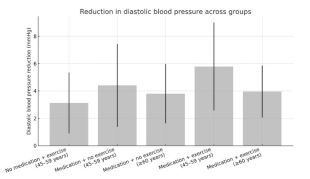
No significant differences were observed in systolic blood pressure reduction between groups (p = 0.666). Significant differences were found for diastolic blood pressure reduction (p = 0.003; η² = 0.22), with the greatest reduction observed in patients aged 45–59 years combining pharmacotherapy with regular physical activity (5.79 ± 3.22 mmHg). Physically active participants also reported healthier lifestyle behaviors and lower pharmacological burden more frequently.
Conclusions:
Regular physical activity was associated with improved diastolic blood pressure control and healthier lifestyle behaviors in hypertensive patients, particularly among younger individuals combining exercise with pharmacotherapy. Further large prospective studies are required to confirm these findings.
Arterial hypertension remains one of the leading risk factors for cardiovascular morbidity and mortality worldwide. Regular physical activity and lifestyle modification are considered essential components of hypertension management alongside pharmacological treatment. This study aimed to evaluate the impact of physical activity and cardiac rehabilitation on blood pressure control, health behaviors, and the effectiveness of pharmacological treatment in patients with arterial hypertension.
Material and methods:
The study included 70 patients with arterial hypertension (59% women, 41% men), divided into two age groups: 45–59 and ≥60 years. Conducted at the Municipal Hospital in Bielsko-Biała between May and November 2023, the study used a 36-question survey assessing physical activity, treatment, and anthropometric data. Statistical analysis included ANOVA and Tukey’s HSD test, with significance set at p < 0.05.
Results:
No significant differences were observed in systolic blood pressure reduction between groups (p = 0.666). Significant differences were found for diastolic blood pressure reduction (p = 0.003; η² = 0.22), with the greatest reduction observed in patients aged 45–59 years combining pharmacotherapy with regular physical activity (5.79 ± 3.22 mmHg). Physically active participants also reported healthier lifestyle behaviors and lower pharmacological burden more frequently.
Conclusions:
Regular physical activity was associated with improved diastolic blood pressure control and healthier lifestyle behaviors in hypertensive patients, particularly among younger individuals combining exercise with pharmacotherapy. Further large prospective studies are required to confirm these findings.
FINANSOWANIE
Badania nie były finansowane ze środków zewnętrznych.
KONFLIKT INTERESÓW
Autorzy deklarują brak konfliktu interesów.
REFERENCJE (28)
1.
Mancia G, Kreutz R, Brunström M, Burnier M, Grassi G, Januszewicz A, et al. 2023 ESH Guidelines for the management of arterial hypertension The Task Force for the management of arterial hypertension of the European Society of Hypertension: Endorsed by the International Society of Hypertension (ISH) and the European Renal Association (ERA). J Hypertens. 2023;41(12):1874–2071. doi: 10.1097/HJH.0000000000003480.
2.
Wang BX. Diagnosis and Management of Hypertensive Heart Disease: Incorporating 2023 European Society of Hypertension and 2024 European Society of Cardiology Guideline Updates. J. Cardiovasc Dev Dis. 2025;12(2):46. doi: 10.3390/jcdd12020046.
3.
Ott C, Schmieder RE. Diagnosis and treatment of arterial hypertension 2021. Kidney Int. 2022;101(1):36–46. doi: 10.1016/j.kint.2021.09.026.
4.
Flack JM, Adekola B. Blood pressure and the new ACC/AHA hypertension guidelines. Trends Cardiovasc Med. 2020;30(3):160–164. doi: 10.1016/j.tcm.2019.05.003.
5.
Masenga SK, Kirabo A. Hypertensive heart disease: risk factors, complications and mechanisms. Front Cardiovasc Med. 2023;10:1205475. doi: 10.3389/fcvm.2023.1205475.
6.
Gordon BDH, Zacherle EW, Whitmire S, Leamy LJ, Bennett JM, Marino JS, et al. Isometric exercise and blood pressure: 12 weeks of training and detraining in the elderly. J Clin Exerc Physiol. 2023;12(1):3–11. doi: 10.31189/2165-6193-12.1.3.
7.
Valenzuela PL, Carrera-Bastos P, Gálvez BG, Ruiz-Hurtado G, Ordovas JM, Ruilope LM, et al. Lifestyle interventions for the prevention and treatment of hypertension. Nat Rev Cardiol. 2021;18(4):251–275. doi: 10.1038/s41569-020-00437-9.
8.
Zieleniewicz P, Wierucki Ł, Kalarus Z, Stokwiszewski J, Grodzicki T, Opolski G, et al. Hypertension in the Polish elderly: Insights into prevalence, awareness, treatment, and control from the NOMED-AF study. Kardiol Pol. 2024;82(7–8):727–732. doi: 10.33963/v.phj.100639.
9.
Zhang X, Niu X, Wang M, Li Q, Feng H, Wang Y, et al. Association between physical activity trajectories and successful aging in middle-aged and elderly Chinese individuals: a longitudinal study. BMC Public Health. 2025;25(1):1812. doi: 10.1186/s12889-025-23021-7.
10.
Mach F, Baigent C, Catapano AL, Koskinas KC, Casula M, Badimon L, et al. 2019 ESC/EAS Guidelines for the management of dyslipidaemias: lipid modification to reduce cardiovascular risk. Eur Heart J. 2020;41(1):111–188. doi: 10.1093/eurheartj/ehz455.
11.
Wattanapisit A, Ng CJ, Angkurawaranon C, Wattanapisit S, Chaovalit S, Stoutenberg M. Summary and application of the WHO 2020 physical activity guidelines for patients with essential hypertension in primary care. Heliyon. 2022;8(10):e11259. doi: 10.1016/j.heliyon.2022.e11259.
12.
Pelliccia A, Sharma S, Gati S, Bäck M, Börjesson M, Caselli S, et al. 2020 ESC Guidelines on sports cardiology and exercise in patients with cardiovascular disease. Eur Heart J. 2021;42(1):17–96. doi: 10.1093/eurheartj/ehaa605.
13.
Lach J, Śliż D, Wiecha S, Price S, Brzozowski A, Mamcarz A. How to calculate a maximum heart rate correctly? Folia Cardiol. 2022;17(5):289–292. doi: 10.5603/FC.2022.0057.
14.
Visseren FLJ, Mach F, Smulders YM, Carballo D, Koskinas KC, Bäck M, et al. 2021 ESC Guidelines on cardiovascular disease prevention in clinical practice. Eur Heart J. 2021;42(34):3227–3337. doi: 10.1093/eurheartj/ehab484.
15.
Alpsoy Ş. Exercise and Hypertension. Adv Exp Med Biol. 2020;1228:153–167. doi: 10.1007/978-981-15-1792-1_10.
16.
Koskinas KC, Van Craenenbroeck EM, Antoniades C, Blüher M, Gorter TM, Hanssen H, et al. Obesity and cardiovascular disease: an ESC clinical consensus statement. Eur Heart J. 2024;45(38):4063–4098. doi: 10.1093/eurheartj/ehae508.
17.
Martin L, White MP, Hunt A, Richardson M, Pahl S, Burt J. Nature contact, nature connectedness and associations with health, wellbeing and pro-environmental behaviours. J Environ Psychol. 2020;68:101389. doi: 10.1016/j.jenvp.2020.101389.
18.
MacDonald HV, Johnson BT, Huedo-Medina TB, Livingston J, Forsyth KC, Kraemer WJ, et al. Dynamic Resistance Training as Stand-Alone Antihypertensive Lifestyle Therapy: A Meta-Analysis. J Am Heart Assoc. 2016;5(10):e003231. doi: 10.1161/JAHA.116.003231.
19.
Saco-Ledo G, Valenzuela PL, Ruiz-Hurtado G, Ruilope LM, Lucia A. Exercise Reduces Ambulatory Blood Pressure in Patients With Hypertension: A Systematic Review and Meta-Analysis of Randomized Controlled Trials. J Am Heart Assoc. 2020;9(24):e018487. doi: 10.1161/JAHA.120.018487.
20.
de Barcelos GT, Heberle I, Coneglian JC, Vieira BA, Delevatti RS, Gerage AM. Effects of Aerobic Training Progression on Blood Pressure in Individuals With Hypertension: A Systematic Review With Meta-Analysis and Meta-Regression. Front Sports Act Living. 2022;4:719063. doi: 10.3389/fspor.2022.719063.
21.
Hayes P, Ferrara A, Keating A, McKnight K, O’Regan A. Physical Activity and Hypertension. Rev Cardiovasc Med. 2022;23(9):302. doi: 10.31083/j.rcm2309302.
22.
Liu J, Li Y, Ge J, Yan X, Zhang H, Zheng X, et al. Lowering systolic blood pressure to less than 120 mm Hg versus less than 140 mm Hg in patients with high cardiovascular risk with and without diabetes or previous stroke: an open-label, blinded-outcome, randomised trial. Lancet. 2024;404(10449):245–255. doi: 10.1016/S0140-6736(24)01028-6.
23.
Dunlay SM, Witt BJ, Allison TG, Hayes SN, Weston SA, Koepsell E, et al. Barriers to participation in cardiac rehabilitation. Am Heart J. 2009;158(5):852–859. doi: 10.1016/j.ahj.2009.08.010.
24.
Kebede T, Taddese Z, Girma A. Knowledge, attitude and practices of lifestyle modification and associated factors among hypertensive patients on-treatment follow up at Yekatit 12 General Hospital in the largest city of East Africa: A prospective cross-sectional study. PLoS One. 2022;17(1):e0262780. doi: 10.1371/journal.pone.0262780.
25.
You Y, Teng W, Wang J, Ma G, Ma A, Wang J, et al. Hypertension and physical activity in middle-aged and older adults in China. Sci Rep. 2018;8(1):16098. doi: 10.1038/s41598-018-34617-y.
26.
Akesson A, Larsson SC, Discacciati A, Wolk A. Low-risk diet and lifestyle habits in the primary prevention of myocardial infarction in men: a population-based prospective cohort study. J Am Coll Cardiol. 2014;64(13):1299–1306. doi: 10.1016/j.jacc.2014.06.1190.
27.
Pescatello LS, Buchner DM, Jakicic JM, Powell KE, Kraus WE, Bloodgood B, et al. Physical activity to prevent and treat hypertension: A systematic review. Med Sci Sports Exerc. 2019;51(6):1314–1323. doi: 10.1249/MSS.0000000000001943.
28.
Hanssen H, Boardman H, Deiseroth A, Moholdt T, Simonenko M, Kränkel N, et al. Personalized exercise prescription in the prevention and treatment of arterial hypertension: a Consensus Document from the European Association of Preventive Cardiology (EAPC) and the ESC Council on Hypertension. Eur J Prev Cardiol. 2022;29(1):205–215. doi: 10.1093/eurjpc/zwaa141.
Udostępnij
ARTYKUŁ POWIĄZANY
| eISSN: | 1734-025X |


Śląski Uniwersytet Medyczny w Katowicach, jako Operator Serwisu annales.sum.edu.pl, przetwarza dane osobowe zbierane podczas odwiedzania Serwisu. Realizacja funkcji pozyskiwania informacji o Użytkownikach i ich zachowaniu odbywa się poprzez dobrowolnie wprowadzone w formularzach informacje, zapisywanie w urządzeniach końcowych plików cookies (tzw. ciasteczka), a także poprzez gromadzenie logów serwera www, będącego w posiadaniu Operatora Serwisu. Dane, w tym pliki cookies, wykorzystywane są w celu realizacji usług zgodnie z Polityką prywatności.
Możesz wyrazić zgodę na przetwarzanie danych w tych celach, odmówić zgody lub uzyskać dostęp do bardziej szczegółowych informacji.
Możesz wyrazić zgodę na przetwarzanie danych w tych celach, odmówić zgody lub uzyskać dostęp do bardziej szczegółowych informacji.